Planning for the Future with a Long-Term State Vision: An Urgent Priority for Latin America and the Caribbean
Work area(s)
The 20th Meeting of the ILPES Regional Council for Planning held in Brasilia on October 2 and 3, 2025, marks a turning point for Latin America and the Caribbean.
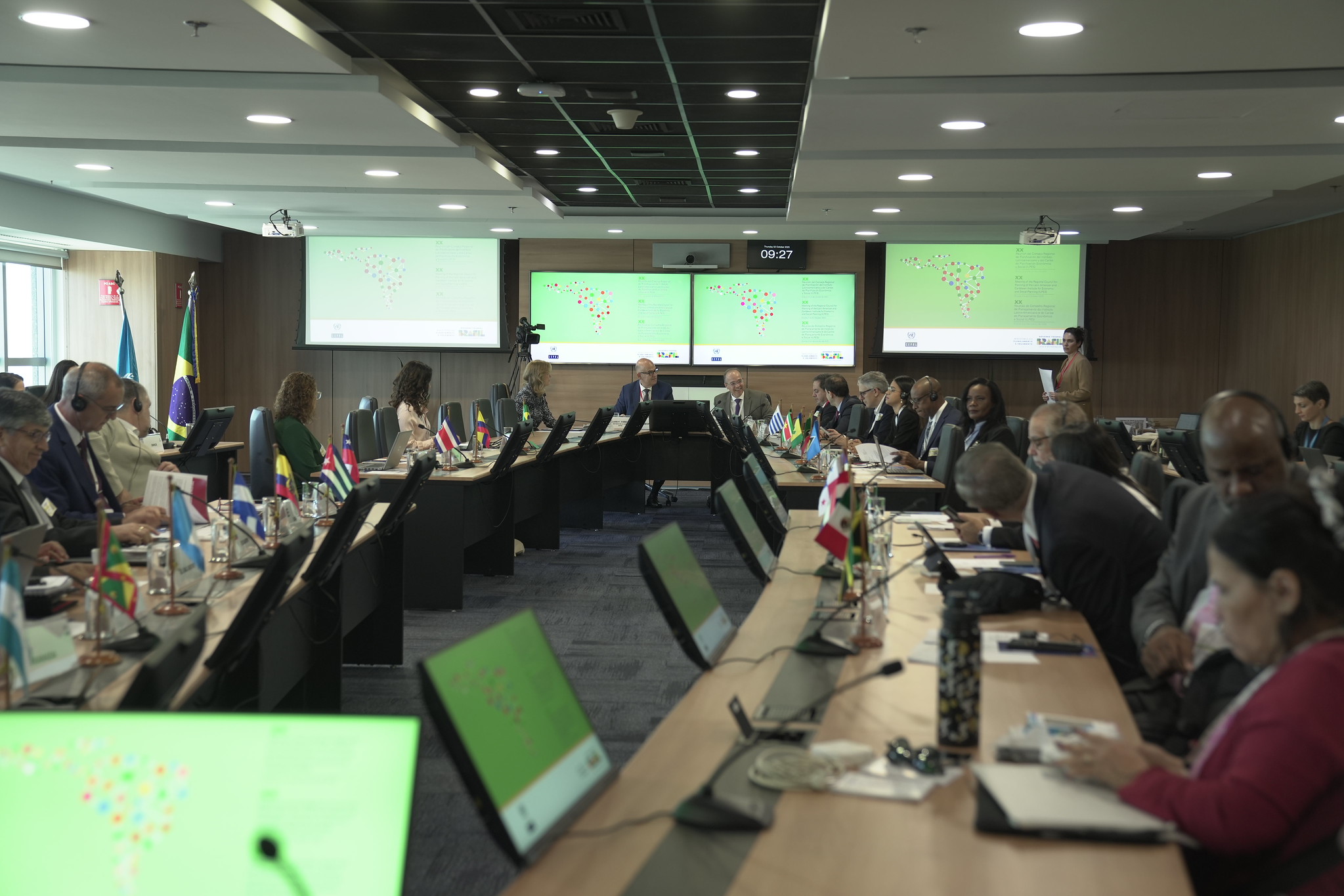
In a context of global uncertainty, political fragmentation, and growing social demands, the countries of the region approved an ambitious Regional Agenda on Governance of Planning and Public Management for Sustainable Development, which represents much more than a technical agreement: it is a collective commitment to building the future with a long-term state vision.
Strengthening State capacities for transformative public action
Latin America and the Caribbean face three structural traps that feed into each other: low capacity for growth and transformation, high inequality and weak social cohesion, and insufficient institutional capacities. Overcoming these traps requires more than just good assessments: it requires managing complex transformations with legitimacy, effectiveness, and a long-term vision.
In this context, planning and public management should no longer be viewed as purely technical or administrative functions. They should become strategic capabilities of the State, capable of bringing together stakeholders, building consensus, and anticipating scenarios. The Regional Agenda clearly expresses this through its four pillars:
- Governance, institutional frameworks and social dialogue, to restore public confidence and strengthen democracy.
- Anticipatory governance and the dimension of the future, to integrate foresight into a world of growing uncertainty.
- Coordination for comprehensive and coherent public policies, to overcome fragmentation and transform catalogs of initiatives into implementation architectures.
- Evaluation, public value, and establishing a culture of continuous learning, to ensure that policies generate results and ongoing improvement.
But planning is not enough. It is essential to have institutions capable of translating assesments into action, sustaining policies beyond electoral cycles, and innovating in the face of changing contexts. For this reason, ECLAC has proposed the TOPP capabilities approach: technical, operational, political, and prospective as a platform for transformative implementation. These capacities are not static attributes, but critical functions that must be activated synergistically so that institutions can lead legitimate, effective, and sustainable processes of change.
This approach shifts the discussion from ideological coordinates to the terrain of the effective conditions for collective action. The focus is not on contrasting models, but on building capacities that enable the design, implementation, and sustainability of public policies with social legitimacy and a long-term horizon.
A regional alliance to drive the implementation of the Regional Agenda
The Regional Agenda has received strong support from regional organizations, United Nations agencies, and development banks, which have expressed their commitment to its implementation. This inter-institutional coordination will enable the mobilization of resources, the sharing of knowledge, and the scaling up of successful interventions, consolidating a regional ecosystem of institutional capacities aligned with the challenges of sustainable development.
The Dominican Republic, in its capacity as Chair of the Regional Council for Planning during the previous period (2023-2025), initiated this process by promoting a participatory, multi-stakeholder approach to the development of the Agenda (See the document Establishing a Regional Agenda for Planning and Public Management: transforming the future of Latin America and the Caribbean for more information).
Currently, Brazil, as the current Chair of the Regional Council for Planning, is responsible for leading its implementation. To this end, it will have the full support of ECLAC and ILPES, which are consolidating their role as strategic partners in translating analyses into concrete lines of action.
Toward innovative, future-oriented public policies
Several countries in the region are currently updating their national development plans with a view to 2050, which represents a unique opportunity to put into practice the principles, tools, and guidelines of this Regional Agenda. In this process, ILPES is available to provide technical assistance, capacity building, and institutional solutions tailored to the realities of each country.
This regional momentum is aligned with the global debates taking place within the framework of the United Nations Summit of the Future, which has placed the need to strengthen global governance and anticipate tomorrow's challenges at the center of the agenda. Issues such as the climate crisis, migration, population aging, and low birth rates cannot be addressed with reactive responses: they require strategic analysis today to build sustainable solutions tomorrow. Foresight planning is therefore an indispensable tool for anticipating disruptions, building resilience, and ensuring that today's decisions are aligned with the development horizons we aspire to achieve.
In this context, public innovation takes on central importance. It is not just a matter of incorporating digital technologies or productive solutions, but of rethinking the way public policies are designed, implemented, and evaluated. Public innovation must also be social and governance-oriented, promoting new forms of citizen participation, policy co-creation, and collaboration among diverse actors. Only in this way can we build institutions that are more open, inclusive, and capable of responding to the complex challenges of our time.
The essence of the Regional Agenda is to move forward together, with strategic cooperation, regional integration, and renewed multilateralism, to transform will into concrete results.
The message is clear: move from the what to the how. The region has increasingly shared analyses and guidelines. What is urgently needed today is to equip ourselves with architecture, capacities, and mechanisms that will enable us to implement these transformations effectively, legitimately, and with a vision for the future.
Citizens cannot wait. Now is the time to turn analyses into decisions and commitments into results. Strategic planning, guided by a long-term state vision and centered on people’s well-being, is the path to building the future we want—starting today.
Related content
Country(ies)
- Latin America and the Caribbean
Related link(s)
-
The 20th Meeting of the ILPES Regional Planning Council:
Regional Agenda on Governance of Planning and Public Management for Sustainable Development in Latin America and the Caribbean:
Establishing a Regional Agenda for Planning and Public Management:
Technical, operational, political and prospective (TOPP) institutional capabilities for managing transformations: