ECLAC participates in Grenada forum on financing climate-resilient water security
Áreas de trabajo
Tema(s)
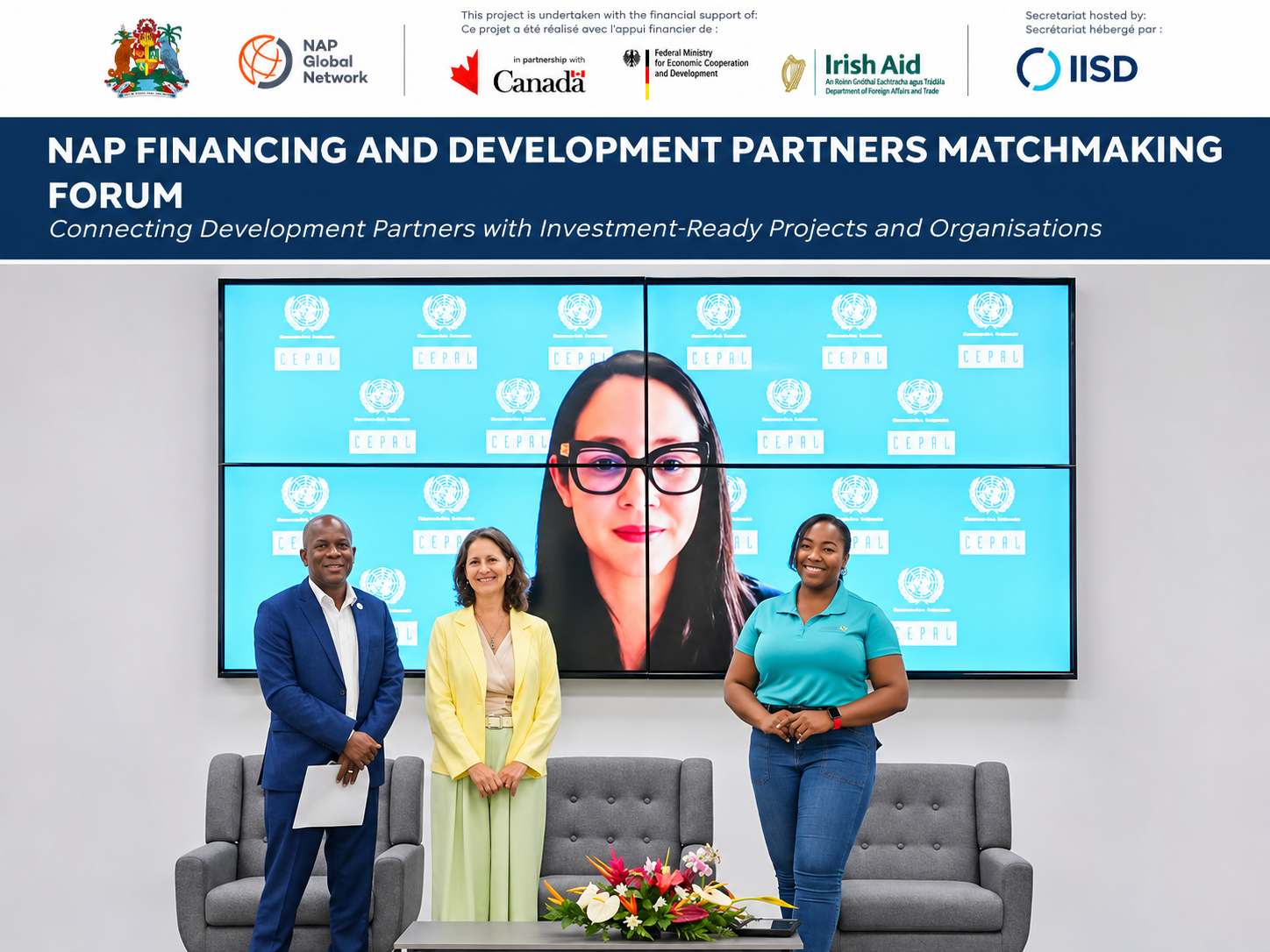
On 30 October 2026, the Economic Commission for Latin America and the Caribbean (ECLAC) participated virtually in the NAP Development Funding Matchmaking Forum held in Grenada under the theme “Connecting Development Partners with Investment-Ready Projects and Organisations”. The event brought together government representatives, financial institutions, development partners, private-sector actors and civil society organizations to support the transition from adaptation planning to implementation and resource mobilization.
Climate-resilient water security was one of the Forum’s three priority investment areas, alongside climate-responsive spatial planning and resilient infrastructure, and climate-resilient food systems. In this context, Silvia Saravia Matus, Economic Affairs Officer in ECLAC’s Natural Resources Division, took part in the panel “Financing Climate-Resilient Water Security”, together with representatives of GIZ and The Nature Conservancy.
During the discussion, ECLAC highlighted that water security is a strategic condition for overcoming the structural development traps facing Latin America and the Caribbean, including low economic growth, persistent inequality, and limited institutional and governance capacities. Water was presented as a “development superconnector” because of its links to productivity, public health, food and energy security, environmental sustainability and climate resilience.
Drawing on the recently published Water Security Financing Framework for Latin America and the Caribbean, ECLAC stressed that one of the main challenges is not only to mobilize more resources, but also to strengthen institutional capacity to transform water-security needs into robust, financeable and implementable investment portfolios.
Among the recommendations discussed for Grenada was the importance of moving from lists of needs to segmented investment portfolios. Interventions such as watershed protection, non-revenue water reduction, water storage, wastewater management and drought resilience have different economic characteristics and therefore require different combinations of funding, financing and institutional arrangements.
ECLAC also presented the five-case methodology incorporated into its Framework — strategic, economic, commercial, financial and management — as a tool to assess from the earliest stages the rationale for an investment, its social and economic benefits, delivery arrangements, costs and sources of finance, and the capacities required for implementation, operation and monitoring.
On financing instruments, ECLAC emphasized that the financing instrument should follow the characteristics of the investment, not the other way around. Investments with high public benefits and limited revenue-generation capacity will continue to require public resources, grants and concessional finance, while blended finance, guarantees and other instruments can help mobilize additional capital when clearly identifiable financial risks constrain investment.
The discussion also highlighted the potential to strengthen the role of domestic financial institutions, aggregate and standardize smaller investments to reduce transaction costs, and make use of circular-economy solutions that can improve the financial sustainability of water and sanitation services. ECLAC also underscored the need to combine international resource mobilization with sustainable domestic sources while protecting affordability and vulnerable households.
As a closing message, ECLAC stressed that moving from water-security priorities to sustainable investments requires strengthening project-preparation capacity, water governance and implementation arrangements simultaneously. These elements are closely linked to the three pillars promoted by ECLAC to accelerate the regional water transition: democratic water governance, appropriate valuation of water, and sustainable financing.
ECLAC’s participation in the Forum contributes to the exchange of experiences between the Caribbean and the rest of Latin America and reinforces the Commission’s work to support countries in closing implementation and financing gaps for water security.