Social and Solidarity Economy: ECLAC's bet to raise productivity and formalize employment in Bolivia
Work area(s)
Topic(s)
Bolivia has one of the highest employment rates in Latin America, but this labor dynamism does not necessarily translate into higher levels of well-being. Low productivity and high informality remain among the country's main structural challenges.
In this context, the Economic Commission for Latin America and the Caribbean (ECLAC) argued that the social and solidarity economy (SSE) can become a key tool to strengthen productive capacities, expand formalization, and improve the population's well-being through the promotion of associativity that the SSE fosters, and the economies of scale this generates.
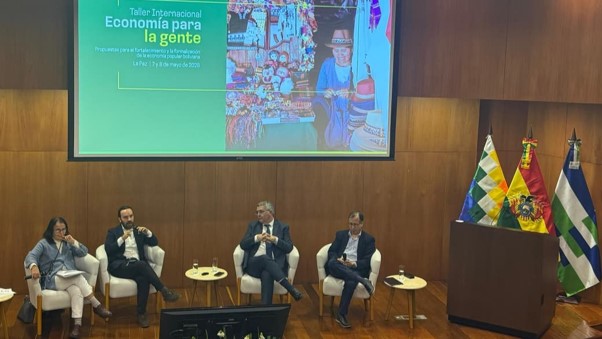
The proposal was presented by Felipe Correa, a social and solidarity economy specialist at ECLAC, during the international workshop Economía para la gente (Economy for the People), organized by the Development Bank of Latin America and the Caribbean (CAF) in La Paz, Bolivia. The meeting brought together specialists and authorities to discuss policies aimed at strengthening the popular, social, and solidarity economy in contexts marked by high levels of informality.
Correa explained that Bolivia is one of the countries in the region with the highest employment rates, but also with low levels of productivity per hour worked. In this context, he maintained that improving the population's well-being necessarily entails raising productivity.
How the social and solidarity economy can contribute to productivity and formalization
During his presentation, the specialist reviewed different approaches to the concept of the social and solidarity economy. He cited, among others, the definition of the International Labour Conference, which includes cooperatives, mutual societies, associations, foundations, and other entities organized around principles of solidarity and cooperation.
Correa argued that, in a context of high informality, there is a predominance of own-account and self-employed workers in the productive system. SSE organizations, and other initiatives for productive coordination among people, generate associativity that, through economies of scale, can increase labor productivity.
However, he warned that "the contribution of the SSE to productivity can depend greatly on the policy context." As he explained, some countries in the region have specific ministerial structures for the social and solidarity economy, while others operate through specialized directorates or mixed schemes of coordination between the State and private actors.
Recommendations for Bolivia
Among the recommendations for Bolivia, Correa highlighted the need to make progress on regulations defining the scope of the social and solidarity economy sector in Bolivia. He also raised the desirability of creating a solid institutional framework, for example through the creation of a Directorate of Social and Solidarity Economy within the Vice-Ministry of Micro and Small Enterprise and Handicrafts.
Finally, these strategies should be integrated into broader productive development policies, coordinated with institutions such as PRO-BOLIVIA, in order to expand instruments of support, financing, and programs aimed at cooperatives, associations, and other organizations of the social and solidarity economy.
For ECLAC, strengthening the social and solidarity economy would not only allow progress in formalizing economic activities, but also open opportunities to raise productivity and improve the well-being of broad sectors of the Bolivian population.
Related content

CEPAL analiza avances y desafíos en consolidación del modelo de sociedades BIC en América Latina
Las sociedades de Beneficio e Interés Colectivo suman más de 5.000 en la región, con mayor presencia en Colombia y Ecuador. Un estudio de la CEPAL ide...
Country(ies)
-
 Bolivia