Latin American and Caribbean Parliamentarians Issue a Global Call for a More Just Climate Future in Historic Legislative Participation at COP30
During COP30, OPCC parliamentary leaders officially launched the Joint Statement of Parliamentarians of Latin America and the Caribbean, which issues a “Global Call for a More Just Climate Future.” The regional document urges nations to join efforts toward a new development model that integrates environmental sustainability, innovation and productive development, social inclusion, and climate justice.
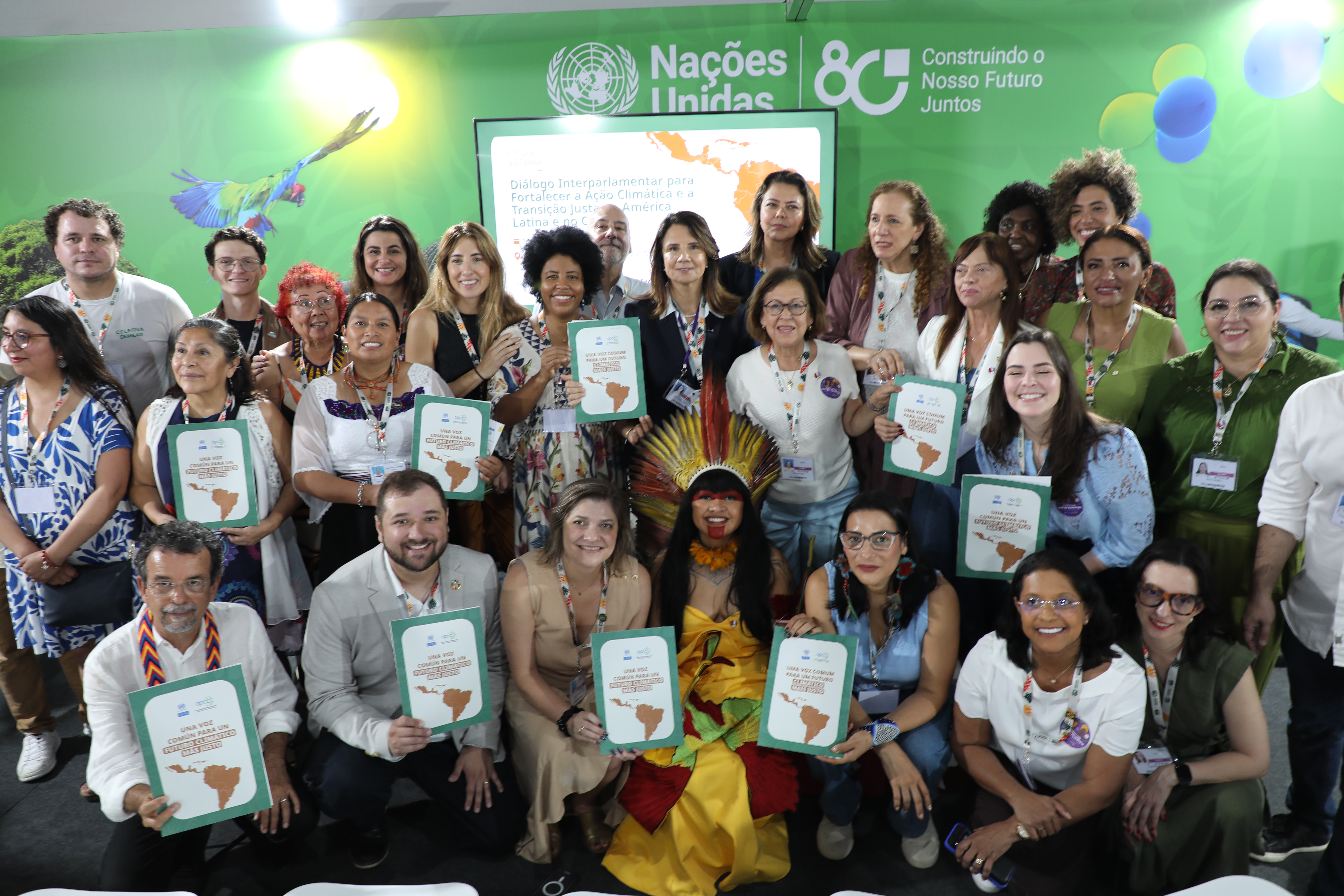
The Parliamentary Observatory on Climate Change and Just Transition (OPCC), an initiative coordinated by the Economic Commission for Latin America and the Caribbean (ECLAC), played a strategic role at the 30th Conference of the Parties to the United Nations Framework Convention on Climate Change (COP30), held from 10 to 21 November 2025 in Belém do Pará, in the Brazilian Amazon. During the event, OPCC parliamentary leaders officially launched the Joint Statement of Parliamentarians of Latin America and the Caribbean, which issues a “Global Call for a More Just Climate Future.” The regional document urges nations to join efforts toward a new development model that integrates environmental sustainability, innovation and productive development, social inclusion, and climate justice.
The OPCC’s participation at COP30 marked a milestone in its history of engagement in global climate conferences. The Statement is the result of regional parliamentary dialogues in preparation for COP30, initiated at the II Parliamentary Summit on Climate Change and Just Transition of Latin America and the Caribbean, held in Brasília on 6–7 August 2025. The Statement gathers the signatures of 49 parliamentarians from 14 countries across Latin America and the Caribbean (access the full text and list of signatories in the right-hand menu) and was handed directly to the COP30 CEO, Ms. Ana Toni. The document reaffirms the central role of parliamentarians in transforming multilateral commitments into national public policies, highlighting topics such as climate justice, sustainable energy transition, governance of strategic minerals, protection of biomes and oceans, climate finance, and the strengthening of democratic institutions in the face of the environmental crisis.
The launch event of the Joint Statement, entitled “Inter-Parliamentary Dialogue to Strengthen Climate Action and Just Transition in Latin America and the Caribbean,” took place on 13 November at the UN Brazil Pavilion at COP30, with support from Plataforma CIPÓ. During the event, Ms. Ana Toni, CEO of COP30, emphasized the leadership role of parliaments in implementing climate commitments and building a more just future. Joining her on the panel were Brazilian Federal Senator Leila Barros, President of the Federal Senate’s Special Subcommittee for COP30; Brazilian Federal Deputies Célia Xakriabá, Fernando Mineiro, and Alice Portugal; Cecilia Nicolini, Argentine parliamentarian of the Mercosur Parliament (Parlasur); Peruvian Congresswoman Ruth Luque; and Ecuadorian Assembly Member Cecilia Baltazar. They shared experiences of climate action from their respective legislatures and highlighted opportunities for significant progress on the climate agenda emerging from Belém.
The debate was moderated by Gabriela Oliveira, National Programme Management Officer at ECLAC, with the participation of Santiago Lorenzo, Chief of ECLAC’s Climate Change Economics Unit, and Mariana Rondón, Programme Director at Plataforma CIPÓ.
On the occasion, Senator Leila Barros highlighted that the Statement is the outcome of an institutional effort by the region’s parliaments, representing “a political, ethical, and collective commitment by the region’s parliaments to a more just climate future.” She stressed that “this is not just another COP; this is the COP that must turn promises into concrete actions,” noting that decades of agreements must be translated into “public policies, legal frameworks, and real investments.”
Active participation and regional representativeness
Since its creation in 2021, the Parliamentary Observatory on Climate Change and Just Transition (OPCC) has consolidated itself as an innovative platform for regional legislative coordination, aimed at building a common agenda for the just transition in Latin America and the Caribbean. Resulting from coordination among parliamentarians of the region, the OPCC promotes the exchange of experiences, comparative legislative analysis, and the strengthening of institutional capacities by providing a data platform of more than 2,600 environmental laws, bills and proposals, and climate framework laws from 28 countries of the region, available at opcc.cepal.org
The OPCC’s participation at COP30, in Belém, Brazil, reaffirmed the commitment of parliamentary leaders of the region to an ecological transition centered on equity and social justice and anchored in a strong strategy of green productive development. The initiative reinforces the OPCC’s ability to mobilize leadership and propose convergences around common and transformative principles.
Joint Statement’s six strategic axes
The Statement brings together six fundamental axes:
- Reaffirmation of multilateral commitments – including the 2030 Agenda, the Paris Agreement, the Escazú Agreement, and the Sendai Framework.
- Latin American and Caribbean context – recognition of the specific vulnerabilities of the region: forced displacements, biodiversity loss, water insecurity, and racial, gender, and territorial inequalities.
- Guiding principles – such as environmental non-regression, common but differentiated responsibilities, just transition, productive inclusion, South-South cooperation, environmental democracy, and social participation.
- Thematic priorities for COP30 – which include just energy transition, strategic minerals for the transition, methane, biomes and oceans, water as a human right, sustainable agriculture and circular economy, low-carbon urban mobility and logistics, risk and disaster management, climate displacements, especially of the Caribbean Small Island Developing States (SIDS).
- Commitments within parliamentary mandates – legislation, budgets, oversight mechanisms, integration between national and subnational levels, social participation, budget frameworks with climate criteria, transparency, free and informed consultation.
- Inter-parliamentary cooperation – connection among parliamentarians, strengthening of capacities, and promotion of climate justice so that Latin America and the Caribbean may be a beacon of dialogue, solidarity, and sustainable solutions for the world.
The Joint Statement strengthens the region’s parliamentary network, expands parliamentarians' connection with the global climate agenda, consolidates the strategic importance of innovation and green and inclusive productive development, and expresses commitment to justice, equity, and concrete legislative action, including solidarity with the Caribbean Small Island Developing States (SIDS).
OPCC parliamentary agenda at COP30
The OPCC carried out and supported the main events with parliamentarians during COP30:
The OPCC inaugurated its participation at COP30 with the event What to do today for a more inclusive, productive, and sustainable future? Potentials of green productive development policies and legislation in Brazil and Mexico, on 11 November – Open Society Foundations Pavilion, co-organized with Plataforma CIPÓ.
The debate addressed, from the perspectives of the Executive and Legislative branches, the potentials of green and inclusive productive development policies in Brazil and Mexico. Participants included Andrea Hurtado, Director-General for Climate Action Policies, Ministry of Environment and Natural Resources of Mexico, and Carina Vitral, General Coordinator of Green Innovation and Just Transition, Ministry of Finance of Brazil, who presented policies such as the Ecological Transformation Plan and the Mexico Plan, aimed at strengthening national production, innovation, and sustainable reindustrialization for a stronger economic insertion of these countries in global value chains. According to Camila Gramkow, Director a.i. of the ECLAC Office in Brasília, by prioritizing green and inclusive productive development, Brazil and Mexico, as well as other countries in the region, will be able to position themselves globally as leaders in providing and adopting green, inclusive, and sustainable solutions. The event also discussed how the Legislative should contribute to these initiatives, driving green and inclusive investments to ensure just economic transitions. Brazilian Federal Deputies Nilto Tatto and Fernando Mineiro highlighted the importance of regulatory frameworks for energy transition, sustainable value chains, and the generation of green jobs in the region.
On 12 November, at the Regional Climate Foundations Pavilion, the event Strengthening Parliamentary Action in the International Climate Agenda: Towards a Decade of Implementation took place, co-organized by OPCC, CIPÓ Platform, Clima de Política, and Climate Parliament. The panelists legislators from Brazil and the region, Deputy Jack Rocha, Deputy Túlio Gadelha, State Deputy Guilherme Cortez (State of São Paulo), and Deputy Cecilia Nicolini (Mercosur Parliament, Argentina), reflected on the strategic role of the legislative branch in the international climate agenda and in the consolidation of inclusive, transparent, and effective governance models, focusing on a vision for the coming decade that strengthens democratic institutions, reduces implementation gaps, and reinforces climate solutions through multilateralism.
Following the Joint Statement launch, the OPCC supported the event organized by the Chamber of Deputies of the National Congress of Brazil at the Brazil Pavilion, The role of Parliament in the NDC implementation agenda. The event discussed how to translate Nationally Determined Contributions (NDCs) into concrete public policies, creating normative frameworks for multilevel governance aligned with the climate ambition proposed in the NDC.
Concluding its participation at COP30, the OPCC, in partnership with GIZ, LACLIMA, Climate Strategies, and ILO Brazil, promoted the event From Compass to Action: Legislating Just Transitions, on 17 November, at the ILO Just Transition Pavilion. The event brought together parliamentarians, private sector representatives, and workers in a tripartite dialogue on environmentally sustainable and socially inclusive climate transitions, highlighting the dimension of productive inclusion.
The event featured the participation of Tendai Makanza, Regional Officer and Director for the Energy Industry and Just Transition at IndustriALL Global Union, who reinforced the centrality of workers’ rights and the connection between just transition, decent work, human rights, and gender equality. Robert Marinkovic, Climate and Green Economy Advisor, International Organisation of Employers (IOE), highlighted the role of the private sector, advocating incentives such as tax relief to support companies committed to a just transition. Bringing concreteness to the dialogue, Colombian parliamentarian Juan Carlos Lozada highlighted a practical example of how to build legislation centered on just transition objectives, presenting the case of the plastics law in Colombia authored by him, which prioritizes employment criteria in the strategy for the gradual reduction of plastic use in the country. Chilean negotiator Luciano Travella concluded the meeting with reflections on the current scenario of UNFCCC negotiations and the need to link global decisions to national action through just transition regulatory frameworks.
Relevance for the region and long-term impact on implementation
The central legacy of the OPCC’s participation at COP30 was contributing to greater visibility and recognition that legislators have an essential role to play in strengthening multilateralism and global climate governance, as they are key actors in translating international commitments into legislative frameworks, public budgets, institutional monitoring, and democratic oversight.
The OPCC will continue promoting coordination, capacity-building, legislative monitoring, and knowledge production activities, with the aim that the Observatory continues contributing to the materialization of the “decade of implementation” of the climate agenda, integrating infrastructure, laws, investments, and social mobilization coherently and regionally.
Access here the OPCC Joint Statement for COP30 and the list of signatories.