ECLAC Shares Latin American and Caribbean Experience in Resilient Energy Planning and Electricity Integration in Xi'an
Work area(s)
Topic(s)
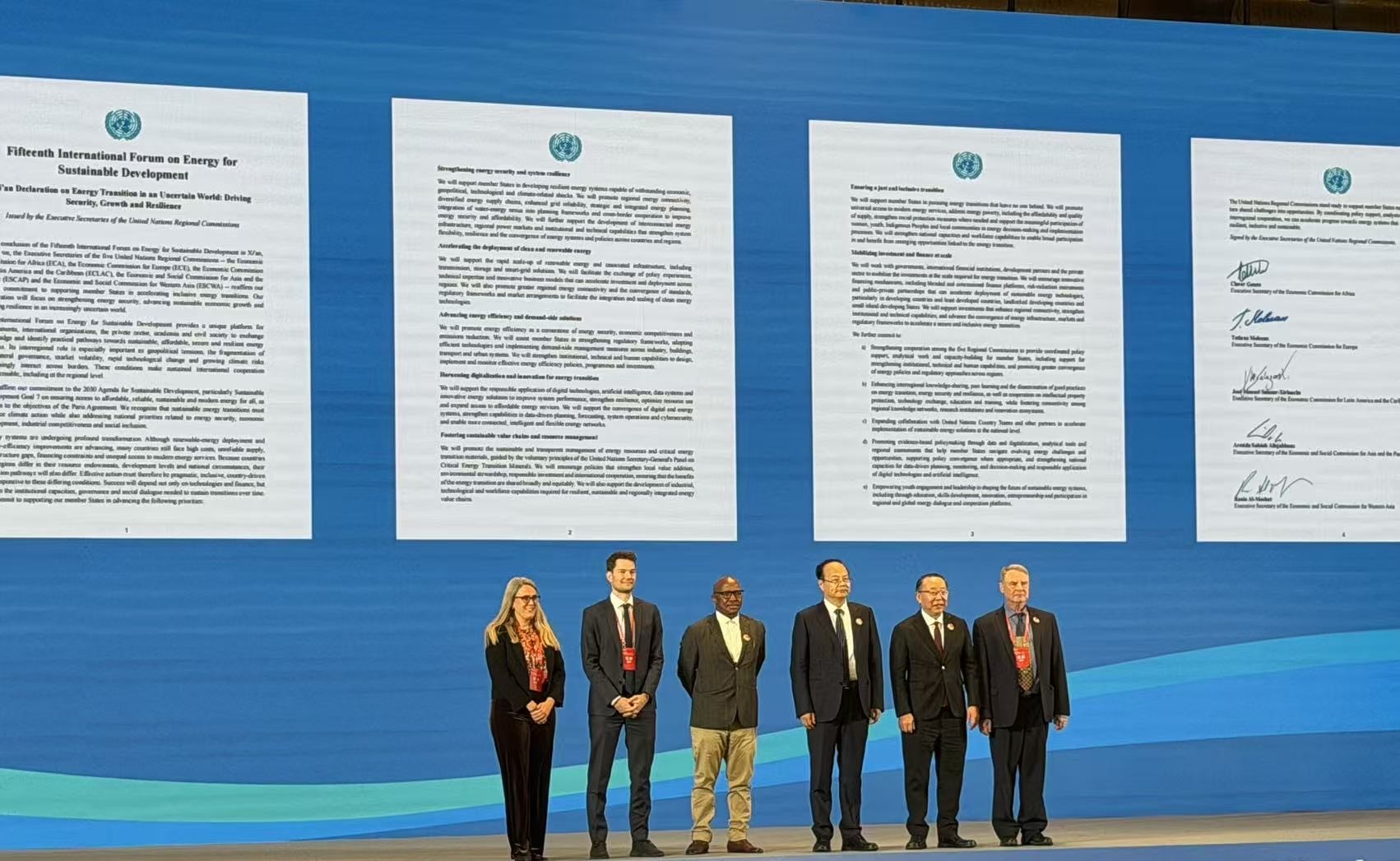
From 3 to 5 November 2026, the Economic Commission for Latin America and the Caribbean (ECLAC) participated in the Fifteenth International Forum on Energy for Sustainable Development (IFESD-15) in Xi'an, China, where it shared the region's experience in resilient energy planning and electricity integration. Its participation took place within the framework of the United Nations Development Account project Supporting increased energy security and resilience through energy transition.
The Forum, co-organized by ECLAC together with the other United Nations Regional Commissions—the Economic Commission for Africa (ECA), the Economic Commission for Europe (ECE), the Economic and Social Commission for Asia and the Pacific (ESCAP) and the Economic and Social Commission for Western Asia (ESCWA)—was held in China for the first time and brought together more than 300 representatives of governments, international organizations, businesses and academia under the theme "Energy Transition in an Uncertain World: Driving Security, Growth and Resilience".
In a video message to the opening session, ECLAC Executive Secretary José Manuel Salazar-Xirinachs highlighted that the region generates more than 60 per cent of its electricity from renewable sources, but that its systems remain exposed to droughts and other climate events. He noted that energy security must be understood in broad terms: beyond a reliable supply, it includes affordability, resilience, technological capabilities and the capacity of countries to adapt. He stressed that energy integration requires not only infrastructure, but also compatible rules, trusted institutions and coordinated planning.
In the session on long-term and resilient energy planning, ECLAC presented the work of the Regional Forum of Energy Planners (FOREPLEN) and its methodology for resilient electricity planning. This methodology has already been applied with Honduras and Paraguay and taught in a regional course to 56 officials from 16 countries. In the session on energy connectivity, ECLAC presented the findings of its study on energy integration in Latin America, which estimates that greater integration with renewable energy could save around 124 billion dollars by 2050. It also presented the case of the interconnection between Costa Rica and Panama, which operates well below its design capacity, and the binational process that ECLAC is supporting to address its technical, regulatory and governance constraints.
On 5 November, at the close of the Forum, the Xi'an Declaration on Energy Transition in an Uncertain World was launched, signed by the Executive Secretary of ECLAC and his counterparts from the other Regional Commissions. Among its priorities, the Declaration includes strengthening energy security and system resilience through regional connectivity and strategic, integrated energy planning.
Through its participation, ECLAC reaffirms its commitment to supporting the countries of Latin America and the Caribbean in building secure, resilient and integrated energy systems, in cooperation with the other Regional Commissions.
Country(ies)
-
 China