ECLAC promotes interregional dialogue between Latin America and the Caribbean and the Arab States to strengthen care policies
Work area(s)
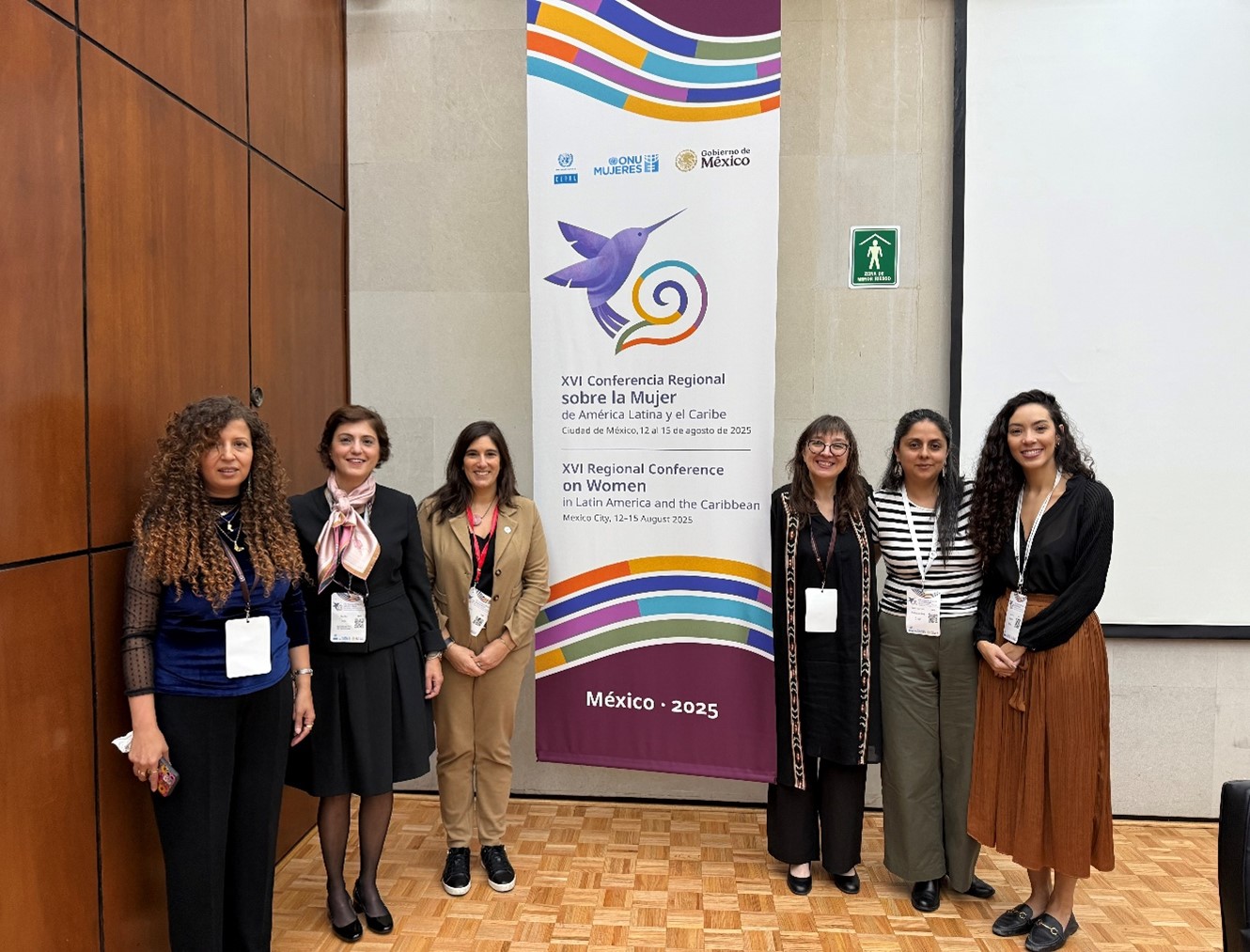
August 15, 2025, Mexico City. In the framework of the XVI Regional Conference on Women in Latin America and the Caribbean, held in Mexico City, the Division for Gender Affairs (DGA) of the Economic Commission for Latin America and the Caribbean (ECLAC) organized the Technical Meeting “Care Policies in Latin America and the Arab States.” The meeting brought together authorities and specialists from both regions to exchange tools, approaches, and lessons learned in the development of comprehensive care systems that promote women’s autonomy based on a logic of social and gender co-responsibility.
This exchange is part of the activities of the project “Advancing care policies for transformative recovery and resilience in Latin America and the Caribbean, Asia-Pacific and the Arab States”. During the opening session, Lucía Scuro, Senior Social Affairs Officer at ECLAC’s Division for Gender Affairs, highlighted that this space represents an opportunity for mutual learning to strengthen cooperation around the care society.
Rouba Arja, Social Affairs Officer at the United Nations Economic and Social Commission for Western Asia (ESCWA), noted that unpaid care work is the main barrier facing women in Western Asia, where nearly two-thirds are outside the labor force. She explained that although the debate on care has gained visibility over the past 15 years, many initiatives in the Arab world remain fragmented and rooted in stereotypes that assign responsibility for care exclusively to women.
The meeting also included the participation of representatives from the Governments of Chile and Brazil, countries that have made significant progress in establishing legal and operational frameworks for the implementation of care systems and policies.
Francisca Gallegos, Subsecretary of Social Services at Chile’s Ministry of Social Development and Family, presented the country’s Comprehensive Support and Care System, Chile Cuida. This policy establishes the right to care as one of the pillars of social protection, grounded in human rights and gender co-responsibility. In Chile, approximately 1.2 million people (6% of the population) are engaged in care work, many under conditions of vulnerability. Among the country’s key achievements, Gallegos highlighted a 400% expansion in home care services and the creation of a caregiver credential, which facilitates priority access to public services. She also emphasized the implementation of community care centers in rural areas, where 86% of participants report improvements in their mental health. On the legislative front, Chile is working to establish Chile Cuida as a state law that also enshrines the right to care.
Carolina Miranda, from the National Secretariat for Care and Family of Brazil’s Ministry of Development and Social Assistance, Family and the Fight Against Hunger, described the country’s rapid progress since 2023. Following the creation of the Interministerial Care Group, the Brazilian Congress approved the National Care Policy in December 2024, recognizing care as work, a need, a right, and a public good, in line with the agreements of the Regional Gender Agenda. This regulation stands out for its intersectional approach, incorporating principles of anti-racism and anti-ableism. In this context, Miranda highlighted innovations such as “Cuidotecas” (safe spaces for children outside school hours) and community laundries designed to reduce the burden of domestic work in households. Brazil has also launched the Care Observatory and the Data Care system to improve governance and monitoring of these policies.
From the Arab region, Samia Smadi, from the Ministerial Committee for Women’s Empowerment at Jordan’s Ministry of Social Development, shared the country’s ambitious reforms under its “Modernization Visions.” Jordan has prioritized childcare as a strategic sector to increase women’s labor force participation.
Legislative reforms in Jordan include extending maternity leave to 90 days in the public sector and requiring companies with more than 15 employees with children to establish childcare centers. Smadi also highlighted the Social Security Law, which introduced subsidies for childcare centers to reduce discrimination faced by women, as well as the Law on the Rights of Persons with Disabilities, which guarantees opportunities in accessibility, education, health, and employment. Despite these advances, Smadi acknowledged that enrollment in childcare centers for children under three remains low due to reliance on informal care (grandparents), which has led the country to launch awareness campaigns such as “Our children are our priority.”
Ana Moreno, Technical Secretary of the Global Alliance for Care, described the origins of this multi-stakeholder platform, which emerged in Latin America under Mexico’s leadership and now includes more than 200 members, including 23 national governments from different regions of the world and international organizations such as ECLAC. Moreno emphasized that the Alliance facilitates South–South and triangular cooperation, enabling local and national governments to exchange promising practices.
At the close of the event, Lucía Scuro reaffirmed ECLAC’s commitment to continue promoting these dialogues. She also announced a special session within the Community of Practice for the Measurement of the Care Society to strengthen interregional learning as part of the activities of the current United Nations project.
