Cooperativism in Brazil: new study analyzes how to strengthen the sector through regional experiences and better measurement systems
Work area(s)
Topic(s)
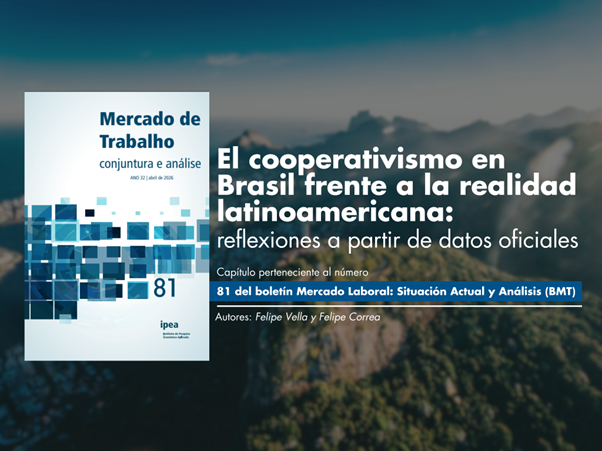
The Economic Commission for Latin America and the Caribbean participates in the analysis of the study Cooperativism in Brazil in light of the Latin American reality: reflections based on official data, included in issue No. 81 of the bulletin Mercado de Trabalho: Conjuntura e Análise, prepared by the Institute of Applied Economic Research (IPEA).
The chapter, written by Felipe Correa, an officer of ECLAC's Productive Development and Business Division, in co-authorship with Felipe Vella Pateo of IPEA, argues that Brazil has a "relatively large and consolidated" cooperative movement. It notes, however, that the sector displays strong heterogeneity and certain difficulties in accessing reliable official data.
An overview of cooperativism in Brazil
Before moving on to the diagnosis, the study distinguishes three major strands within Brazilian cooperativism: the so-called "facade cooperatives," created to circumvent labor legislation; traditional cooperatives, linked mainly to the agro-industrial and financial sectors; and popular cooperativism, associated with self-managed organizations and social movements.
Despite their historical differences, the document points to a growing convergence between traditional and popular cooperativism, particularly in the legislative arena. This convergence is reflected in Law No. 15,068/2024, which establishes the National System of Solidarity Economy and incorporates both the Organization of Brazilian Cooperatives (OCB) and the National Union of Solidarity Cooperative Organizations (Unicopas).
The challenge of measuring cooperativism
One of the study's main contributions is its analysis of the methodological limitations involved in quantifying Brazilian cooperativism. The authors review various sources of information used over recent decades, including the Agricultural Census, the Business Register of the Brazilian Institute of Geography and Statistics (IBGE), and the Annual Social Information Report (Rais), prepared by the Ministry of Labor and Employment.
The research holds that the transition from the Rais platform to the eSocial system led to a significant discontinuity in records concerning the number of members, as specific information on cooperative members ceased to be requested. According to the document, this change drastically reduced the capacity to measure cooperative ties in strategic sectors such as agriculture and finance.
Against this backdrop, the authors maintain that Brazil needs to develop new measurement strategies drawing on tools such as eSocial, the tax records of the Receita Federal, and the Cempre/IBGE databases, with a view to reconstructing more precise statistical information on the cooperative sector.
A region with diverse models
The study incorporates a regional comparison drawn from ECLAC information on cooperativism in Latin America. The data show that, unlike the predominant trend in the region since the 1990s, Brazil and Colombia are the only countries where the number of registered cooperatives has declined.
In the Brazilian case, this decline began in 2006 and was associated mainly with merger and acquisition processes in sectors such as agribusiness and cooperative credit. Moreover, despite having the largest absolute number of cooperatives, Brazil appears alongside Mexico and Chile among the countries with the lowest proportion of cooperative ties relative to their population.
The contrast is particularly evident vis-à-vis countries such as Uruguay, Argentina, and Ecuador, where the cooperative tradition has a much more widespread presence in economic and social life.
Another relevant finding of the study is that Brazil shows one of the lowest levels of territorial inequality in the distribution of cooperatives per inhabitant among the countries analyzed. The research suggests that this phenomenon could be related to the strength of rural cooperativism and to public policies such as the National School Feeding Programme, which historically encouraged the organization of family-farming cooperatives to supply demand for school meals.
In its conclusions, the study argues that Brazil has room to incorporate sectoral experiences from other countries in the region and, at the same time, to move toward an integrated information system that would allow for a more accurate understanding of the economic and social scope of cooperativism in the country.
The article can be consulted at this link.
Related content

CEPAL participó en primera versión de Congreso sobre Economía Social, Solidaria y Cooperativismo en Brasil
El encuentro, organizado por la Universidad Federal de Río de Janeiro, se realizó entre el 24 y 26 de agosto.