ECLAC promotes the exchange of Chile’s experience in the lithium value chain with countries of Latin America and the Caribbean and East Asia
Work area(s)
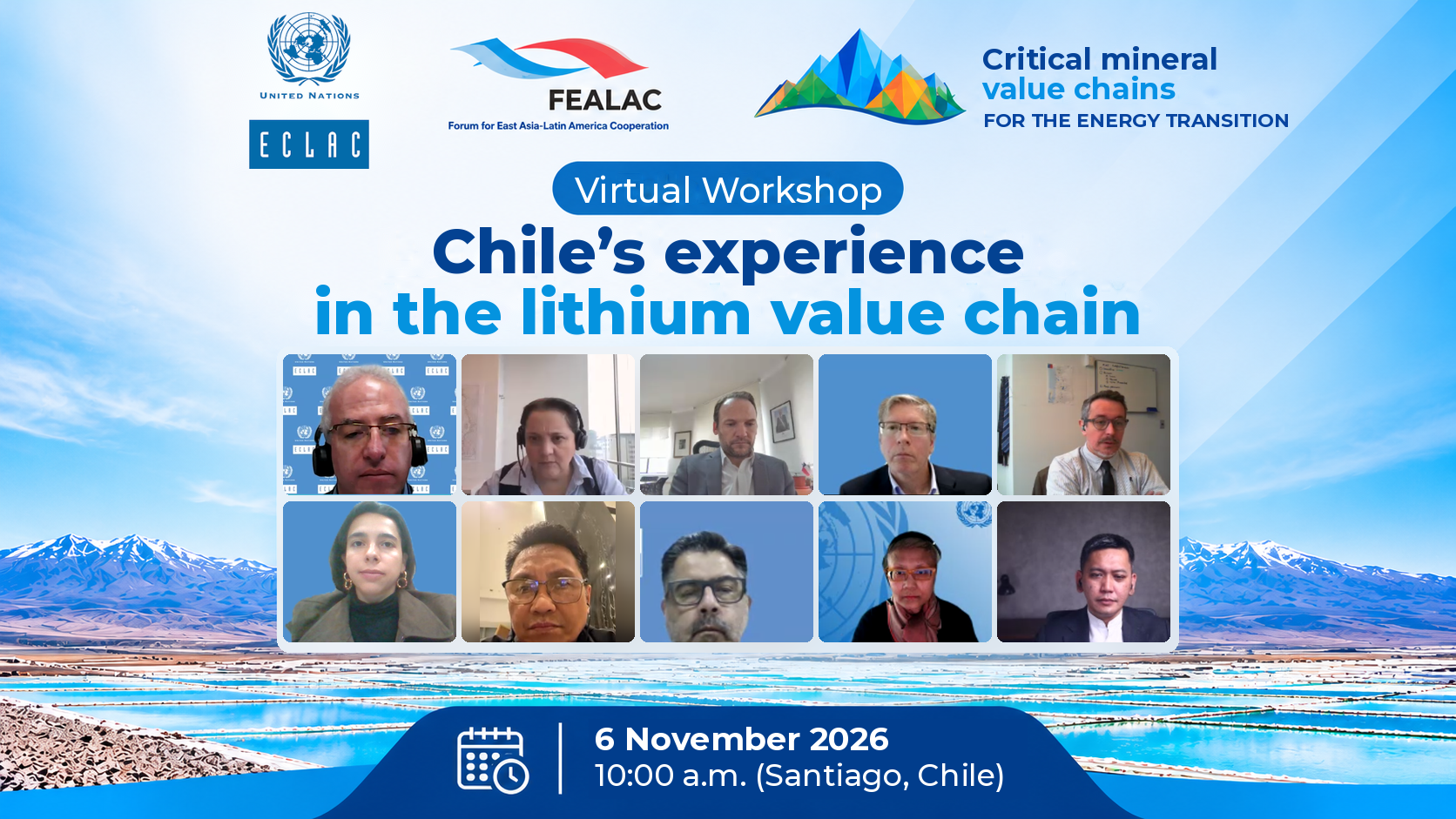
On 6 November 2026, the Economic Commission for Latin America and the Caribbean (ECLAC) and the Ministry of Mining of Chile held the virtual workshop “Chile’s experience in the lithium value chain”. It is the first in a series of national workshops to be held under the Interregional Cooperation Project on Critical Mineral Value Chains for the Energy Transition of the Forum for East Asia-Latin America Cooperation (FEALAC), implemented by ECLAC and the United Nations Economic and Social Commission for Asia and the Pacific (ESCAP). The workshop brought together officials, experts and representatives from Brazil, Chile, Colombia, Guatemala, Peru, the Philippines, Indonesia and Thailand.
In his opening remarks, Mauricio León, Officer-in-Charge of ECLAC’s Natural Resources Division, noted that Latin America and the Caribbean holds a strategic position in the global energy transition, accounting for 39% of the world’s lithium reserves and 33% of global production. He also pointed out that Chile is the world’s third-largest producer of this mineral, with 19% of global production and 25% of global reserves.
However, Mr. León cautioned that mineral wealth does not automatically translate into productive capacity or sustainable development: having minerals does not necessarily mean having production, and production alone does not guarantee development. Moving towards higher value-added activities, he stressed, requires proactive public policies that promote investment, human talent, innovation and institutional strengthening, and that ensure these processes are compatible with environmental protection, respect for community rights and the effective participation of Indigenous Peoples.
The workshop was structured around three main pillars: (i) the regulatory and institutional framework governing lithium development in Chile; (ii) progress and challenges in building a more sophisticated value chain; and (iii) the exchange of international experiences with Asian countries.
In the first segment, María Luisa Baltra, Head of the Mining Strategy and Public Policy Division of the Ministry of Mining, presented the distinctive features of Chile’s lithium regulatory regime. She explained that, given the strategic status that lithium has been granted under Chilean law, the mineral cannot be subject to mining concessions, so new projects will be developed through Special Lithium Operating Contracts (CEOLs). She also outlined the main guidelines of the National Mining Policy 2050 and the Mining Programme 2026–2030, which aim to strengthen the sustainability of the sector, promote investment and provide legal certainty. Among recent developments, she highlighted the enactment of Law No. 21,853, which simplifies the mining licence fee regime.
The following presentations focused on the evolution and outlook of Chile’s lithium value chain. Christian Sanhueza, Adviser to the Office of the Undersecretary of Mining, outlined the growth projections for Chile’s production of lithium compounds and underscored the value of Indigenous consultation processes as a good governance practice, drawing attention to the agreements reached with Indigenous communities and the establishment of permanent mechanisms for dialogue and follow-up.
Subsequently, Fernando Hentzschel, Manager of Technological Capabilities at the Chilean Economic Development Agency (CORFO), presented the initiatives under way to promote value addition and technological development linked to lithium. These include the reinvestment in research and development of revenues from CORFO’s mining holdings in the Salar de Atacama, efforts to advance direct lithium extraction (DLE) technologies, and projects related to lithium metal and the recovery of minerals from tailings, as well as the opportunities offered by battery recycling in the context of the transition to electric mobility.
Lastly, the workshop incorporated an international perspective through contributions from Asian representatives. Engr. Bernardo Bitanga, Chief of the Metallurgical Technology Division of the Mines and Geosciences Bureau (MGB) of the Philippines, highlighted Chile’s experience as a benchmark for critical minerals governance, particularly regarding the reinvestment of mining rents in innovation and its mechanisms for engagement with communities. Putra Adhiguna, Managing Director of the Energy Shift Institute, shared lessons from Indonesia’s experience in developing its nickel industry, emphasizing the importance of properly managing the pace of the sector’s expansion and identifying opportunities to move towards higher value-added activities.
Taken together, the presentations underscored that developing the lithium value chain requires not only an extensive mineral resource base but also, among other key elements, regulatory frameworks that facilitate investment and promote responsible and sustainable exploitation; productive and technological capabilities that make it possible to meet demand while also generating value addition and innovation; and mechanisms for territorial dialogue that contribute to transparency and to the participation of communities and Indigenous Peoples. All of this is essential to make the energy transition, which is driving the development of the lithium value chain and related chains, more just and inclusive.
The final segment of the workshop was devoted to an exchange of experiences and reflections among representatives from Latin America and the Caribbean and East Asia, which highlighted the common challenges both regions face in developing critical mineral value chains.
During the dialogue, Murtiani Hendriwardani, Critical Minerals Adviser at ESCAP, noted that several countries in Asia and the Pacific are formulating and implementing national critical minerals strategies, making Chile’s experience a reference of particular interest in terms of governance, institutional frameworks and capacity-building.
In response to questions from participants, representatives of the Ministry of Mining elaborated on the particularities of the lithium regulatory regime and on the opportunities offered by the reprocessing of tailings, which are increasingly regarded as “anthropogenic deposits” with potential for the recovery of strategic minerals such as cobalt, rare earths and other high-value elements.
The discussion also addressed the challenges of capturing value from mineral resources. In this context, Fernando Hentzschel stressed that Chile’s strategic goal should not simply be to increase its lithium production, but to establish itself as the world’s most sustainable and competitive supplier. To this end, he pointed to the importance of fostering innovation, technological development and new productive capabilities, while acknowledging the constraints posed by the small size of the domestic market and the uncertainty associated with the sector’s rapid technological evolution.
In his concluding remarks, Mauricio León emphasized that the sustainable use of critical minerals requires a long-term vision based on broad coordination among public institutions, the private sector, communities and actors in the scientific and technological system. He also underscored that regional and interregional cooperation is fundamental to facilitating knowledge exchange, strengthening capacities and promoting strategies to generate greater value added from mineral resources in both regions.
Finally, it was noted that the contributions and experiences shared during the workshop will serve as a key input for a case study on the lithium value chain in Chile, to be developed under the FEALAC project. It was also announced that the initiative will continue with further national workshops in other participating countries, with the aim of deepening comparative analysis and strengthening opportunities for mutual learning and cooperation between the countries of both regions.
Related content
Taller virtual: La experiencia de Chile en la cadena de valor del litio
El Taller virtual: La experiencia de Chile en la cadena de valor del litio busca promover el intercambio de conocimientos y experiencias entre autorid...
Country(ies)
-
 Chile
