ECLAC and the United Nations Regional Commissions Sign the Xi’an Declaration to Advance Secure, Affordable, Resilient and Inclusive Energy Systems
Work area(s)
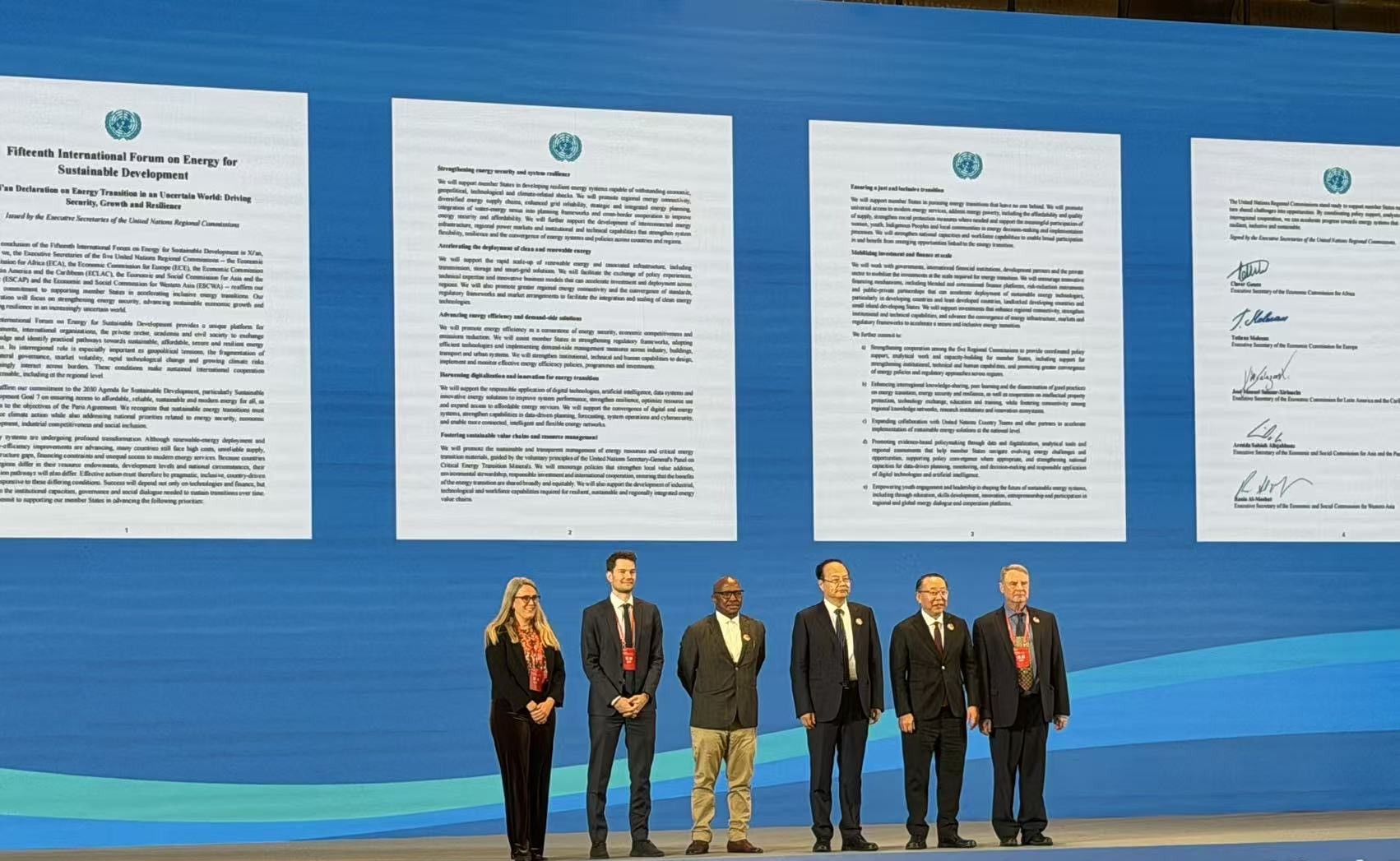
On 5 November 2026, the Xi’an Declaration on Energy Transition in an Uncertain World was launched in Xi’an, China. It was signed by the Executive Secretary of the Economic Commission for Latin America and the Caribbean (ECLAC), José Manuel Salazar-Xirinachs, together with his counterparts from the other United Nations Regional Commissions. The signatories also included Claver Gatete, Executive Secretary of the Economic Commission for Africa (ECA); Tatiana Molcean, Executive Secretary of the Economic Commission for Europe (ECE); Armida Salsiah Alisjahbana, Executive Secretary of the Economic and Social Commission for Asia and the Pacific (ESCAP); and Rania Al-Mashat, Executive Secretary of the Economic and Social Commission for Western Asia (ESCWA).
In the declaration, the Regional Commissions commit to supporting member States in pursuing inclusive, country-specific energy transitions, as well as strengthening joint cooperation.
They establish seven priorities:
- Strengthening energy security and system resilience;
- Accelerating the deployment of clean and renewable energy;
- Advancing energy efficiency and demand-side solutions;
- Harnessing digitalization and innovation for the energy transition;
- Fostering sustainable value chains and the sustainable and transparent management of energy resources and critical minerals for the energy transition;
- Ensuring a just and inclusive transition;
- Mobilizing investment and finance at scale.
The Forum, organized by the five Regional Commissions, with ESCAP serving as the host, brought together governments, international organizations, the private sector, academia and civil society from 3 to 6 November. This was the fifteenth edition of this interregional forum.
In his opening remarks, the Executive Secretary of ECLAC highlighted that Latin America and the Caribbean generates more than 60 per cent of its electricity from renewable sources. He stressed that the energy transition must transform the way economies grow through productive development policies, regional cooperation and stronger institutional capacities. To harness the benefits of the transition, countries need productive development policies that strengthen local capacities, foster innovation, support workforce development and link energy investments to national and regional value chains. This requires strong institutions and effective governance.
He also noted that we are undergoing a period of profound transformation. Geopolitical shifts, climate impacts, trade fragmentation, technological disruption and changing investment patterns are reshaping the global energy landscape. In this context, energy security must be understood in broader terms. Beyond ensuring a reliable energy supply, it requires promoting affordability, resilience, technological capabilities and environmental sustainability, as well as countries’ ability to adapt to an increasingly uncertain future.
He underscored that, in the current geopolitical context, regional cooperation is more important than ever. Greater energy integration can help countries diversify their energy supply, improve reliability, reduce costs and accelerate the deployment of renewable energy. However, integration is not limited to infrastructure. It also requires institutions that foster trust, regulatory frameworks that facilitate cooperation, coordinated planning processes and sustained political commitment.
Finally, he emphasized that the energy transition is not merely a technical undertaking. Its success depends on the ability of public institutions to manage complexity, coordinate interests and anticipate change.
During the session on long-term energy planning, ECLAC presented its tools for resilient planning: the Regional Forum of Energy Planners (FOREPLEN), the methodology for resilient electricity planning, applied in Honduras and Paraguay, and the methodological guide for energy transition plans. In the session on connectivity, ECLAC presented its study on energy integration, which estimates that greater integration based on renewable energy could generate savings of approximately 124 billion dollars by 2050, as well as the case of the interconnection between Costa Rica and Panama. At the workshop on critical minerals for the energy transitionv, ECLAC shared lessons from a regional case study on the application of the United Nations Resource Management System (UNRMS), a tool that promotes the transparent and responsible management of these minerals and greater value capture in producing countries.
Through its participation, ECLAC reaffirms its commitment to supporting countries across the region in advancing secure, resilient and just energy transitions, in cooperation with the other Regional Commissions.
Related content

15th International Forum on Energy for Sustainable Development
The 15th International Forum on Energy for Sustainable Development (IFESD15) will be held from 3 to 6 November 2026 in Xi'an, China. Jointly organized...