Bi-regional Exchange promotes time use measurements to transition towards the Care Society
Work area(s)
As part of the series of events entitled “Time Use Surveys and their application for the measurement of the Care Society,” countries from Latin America and the Caribbean, Europe, and specialists from the United Nations System discussed methodological and conceptual adjustments in recent applications of time use surveys.
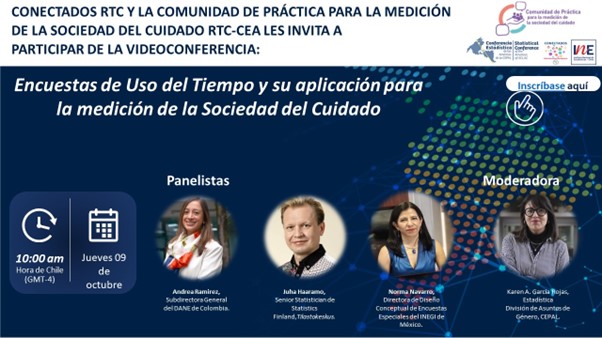
During October and November 2025, two sessions of the meeting “Time Use Surveys and their application for measuring the Care Society” were held, with the participation of representatives from the national statistics offices of Colombia, Mexico, and Finland, in dialogue with the United Nations Statistics Division (UNSD) and the Division for Gender Affairs of ECLAC. These were opportunities to exchange good practices and discuss methodological challenges in the application of Time Use Surveys (TUS) and their use for measuring care in Latin America and the Caribbean and the European Union. This series of conversations is part of the activities of the Community of Practice for the Measurement of the Care Society of the Knowledge Transmission Network of the Statistical Conference of the Americas (RTC-CEA).
The first session was held on October 9th, 2025, and featured presentations by representatives from the national statistics offices of Colombia and Mexico, who shared methodological adjustments and lessons learned from the most recent applications of time-use surveys in both countries. The opening remarks were given by Karen García Rojas, Statistician in ECLAC's Gender Affairs Division, who highlighted the relevance of time-use statistics as fundamental tools for States to recognize the persistence of the sexual division of labor and the unfair social organization of care as a structural challenge of gender inequality. She also highlighted the progress made in both Latin America and the Caribbean and the European Union in consolidating regional standards, such as the Classification of Time Use Activities for Latin America and the Caribbean (CAUTAL), the Methodological Guide on Time Use Measurements, and the Harmonized European Time Use Surveys (HETUS), which have enabled the sustained production of indicators on unpaid care work and the production of services for own use. In a changing global context due to increasing digitalization, among other factors, she emphasized the need to update, strengthen, and use these measurements to respond to the growing demands for information for public care policies.
For her part, Andrea Ramírez Pisco, Deputy Director of Colombia's National Administrative Department of Statistics (DANE), gave a presentation on the methodological aspects and conceptual adjustments of the Fourth National Time Use Survey (ENUT 2024-2025). She highlighted the expansion of national coverage, incorporating areas of the Amazon and Orinoquía regions, as well as a 40% increase in the sample size compared to the previous version. In turn, the ENUT incorporates innovations such as a sample redesign and the inclusion of questions aimed at strengthening the measurement of care, the identification of the migrant population, and question options that address aspects of care from an ethnic perspective. The deputy director of DANE also shared lessons learned in the operational aspect, noting that people tend to underestimate the time spent on their daily activities and that territorial expansion involves logistical and budgetary challenges, especially in remote areas, which requires technical decisions to be made in contexts of limited resources, a common reality in the region.
For her part, Norma Navarro, Director of Conceptual Design for Special Household Surveys at Mexico's National Institute of Statistics and Geography (INEGI), presented the methodological update of the National Time Use Survey 2024. She explained that this process made it possible to modernize the data collection tool to improve data quality and ensure comparability with other institutional sources. Key innovations include the incorporation of variables on disability, care needs, Afro-descendants, and work or study modality, as well as improvements in the measurement of domestic work and care. She particularly highlighted the adjustments in passive care and the inclusion of dimensions on emotional care, the latter associated with affective attention and accompaniment, following the guidelines of the International Classification of Activities for Time Use Statistics (ICATUS 2016), which strengthened the comprehensive measurement of care.
The closing remarks of this first session were delivered by Lucía Scuro, Senior Social Affairs Officer in ECLAC's Gender Affairs Division, who highlighted the value of bi-regional spaces for knowledge sharing and the adaptation of international good practices to the contexts of Latin America and the Caribbean. She stressed that advances in measuring time use provide a solid basis for the design of evidence-based care policies, although significant challenges remain, particularly in measuring simultaneous activities, perceptions, and health dimensions associated with care.
The second session was held on November 12th, 2025, and featured presentations by representatives from Statistics Finland and the United Nations Statistics Division, followed by a roundtable discussion with representatives from the statistical offices of Colombia and Mexico. The opening remarks were given by Olga Barquero, Head of the Institutional Cooperation Unit of the National Institute of Statistics of Chile, in her capacity as coordinator of the ECA Knowledge Transmission Network, who highlighted the importance of time-use surveys in making women's contribution to the economy visible, highlighting the gender division of labor, and advancing the construction of comprehensive care systems with a gender perspective. In this context, she underscored the relevance of the bi-regional dialogue between Latin America and the Caribbean and Europe, promoted by the Bi-regional Pact on Care, recognized in the Tlatelolco Commitment.
Next, Iliana Vaca-Trigo, Statistician at the United Nations Statistics Division, presented a global overview of time use measurements. She noted that, although significant regional gaps remain, 110 countries have conducted at least one time use survey and 96 report SDG indicator 5.4.1 on the proportion of time spent on unpaid domestic and care work. She also presented the progress made by the Expert Group on Innovative and Effective Ways to Collect Statistics on Time Use (EG-TUS) and the Guide to Producing Statistics on Time Use, approved by the United Nations Statistical Commission in 2024, which promotes harmonized definitions, minimum quality standards, greater international comparability, and the use of minimum harmonized instruments, along with the digitization of diaries as a strategy to improve the efficiency and quality of information.
Subsequently, Juha Haaramo, Senior Statistician at Statistics Finland, shared the experience of the 2021–2022 Time Use Survey, which collected more than 8,000 diaries, mostly digital. He outlined the main challenges associated with coding activities, especially in multitasking contexts, as well as lessons learned regarding participation, the use of multimodal approaches, and the key role of field staff. He also presented results showing relevant changes in the distribution of domestic and care work, with an increase in men's participation and, for the first time, equality in total working time between men and women, although traditional roles persist in certain tasks. Some of these changes could be associated with the effects of the pandemic, which future measurements are expected to clarify.
The session concluded with a roundtable discussion in which Oscar Villamizar, from Colombia's DANE, and Norma Navarro, from Mexico's INEGI, agreed on the need to balance the quality of information with the response burden, strengthen the dissemination and use of data, and advance conceptual and methodological harmonization to improve international comparability. They also highlighted the challenges associated with incorporating new technologies and capturing simultaneous activities in time-use surveys.
Both sessions reaffirmed the relevance of time-use surveys as a strategic input for the design of gender-sensitive public policies and for progressing toward the Care Society. The bi-regional dialogue and exchange between global and regional frameworks and national experiences highlighted both the progress made and the challenges that remain in terms of methodological harmonization, technological innovation, and effective use of information, reinforcing the importance of continuing to strengthen regional and international cooperation in this area.