The idea of development did not arise in the conceptual vacuum of the post-war period; rather, it inherited, and transformed, one of the central categories of modern Western thought: the idea of progress. As J. B. Bury showed in his classic study (1920), and as Robert Nisbet later reconstructed (1980), the conviction that humanity advances cumulatively towards higher conditions of existence took hold between the seventeenth and nineteenth centuries, from Condorcet and his Sketch for a Historical Picture of the Progress of the Human Mind to Comte’s law of three stages. When, in the mid-twentieth century, the international system adopted the language of development (with the 1945 Charter of the United Nations and the successive United Nations Development Decades), this legacy was tacitly incorporated, with its promises and also with assumptions not free of tensions.
This seminar starts from the observation that development, far from being a merely technical or economic category, is a philosophically dense concept, laden with anthropological, ethical, epistemological and political assumptions that should be made explicit and subjected to examination. The philosophy of development, understood as systematic reflection on the ends, means, subjects and forms of knowledge of development, provides the appropriate framework for this task.
A first line of reflection corresponds to the tradition of development ethics, inaugurated by Denis Goulet, who as early as Development Ethics (1965) argued that development should be judged not only by what societies have, but by what people come to be. This line was continued and systematized by Des Gasper, who has critically examined the evaluative languages implicit in development policies (needs, rights, capabilities, efficiency), and by David Crocker, who has articulated an ethics of global development centred on agency, public deliberation and democratic participation, in close dialogue with the approaches of Amartya Sen and Martha Nussbaum. The question this tradition keeps open, what is development and who decides on it?, constitutes a normative starting point.
A second line addresses the conditions of possibility of knowledge about development. The work of Arturo Escobar, particularly Encountering Development: The Making and Unmaking of the Third World (1995), showed how development historically operated as a regime of representation that constituted certain societies as “underdeveloped”, producing the objects, subjects and institutions of its own intervention. Post-development currents invite us to ask from which forms of knowledge, from which territories and from which worldviews what counts as development is defined, opening a dialogue with Indigenous philosophies and with Latin American notions of buen vivir. Without having to give up the concept, this epistemological critique compels us to pluralize it and to situate it in context.
A third line concerns the philosophical and political foundations of development. If development is also political development, that is, the development of political institutions and civic life, then the quality of democracy (in the sense developed by Guillermo O’Donnell and Leonardo Morlino, attending to the rule of law, accountability, participation and responsiveness) and the quality of institutions (whose inclusive or extractive character shapes trajectories of well-being) are properly philosophical objects as well as objects of political science. Behind these debates lies a classic question: what political configuration allows for the effective exercise of the democratic principle? The tradition of democratic republicanism, from Aristotle to its contemporary reformulations (Pettit and Sandel), offers a normative horizon here: freedom as non-domination, civic virtue and well-being as criteria for evaluating political development.
The seminar proposes to articulate these traditions around a multidimensional understanding of development that distinguishes, without separating, five dimensions: human development, referring to the unfolding of people’s capabilities and potentialities; social development, referring to the bonds, cohesion and justice of common life; economic development, referring to productive transformation and the sustained generation of material prosperity; political development, referring to the quality of democracy and institutions; and sustainable development, referring to the relationship of societies with nature and with future generations. The thesis guiding the seminar is that these dimensions converge in the notion of integral development, whose end is human well-being and flourishing: in Aristotelian terms, eudaimonia as the actualization of properly human potentialities, in both individual and collective terms.
The conception of well-being as the ultimate end of integral development connects directly with the most current discussions on its measurement. From the report of the Stiglitz-Sen-Fitoussi Commission (2009) to the Beyond GDP agenda promoted by the United Nations within the framework of “Our Common Agenda” and the debate on the post-2030 framework, the conviction has taken hold that gross domestic product is an insufficient indicator of the progress of societies. The emerging proposal understands human progress in relation to well-being. The seminar will examine the philosophical foundations of this shift: what conception of the good is presupposed when measuring, what is gained and what is lost in quantifying flourishing, and what implications this debate has for Latin America and the Caribbean.
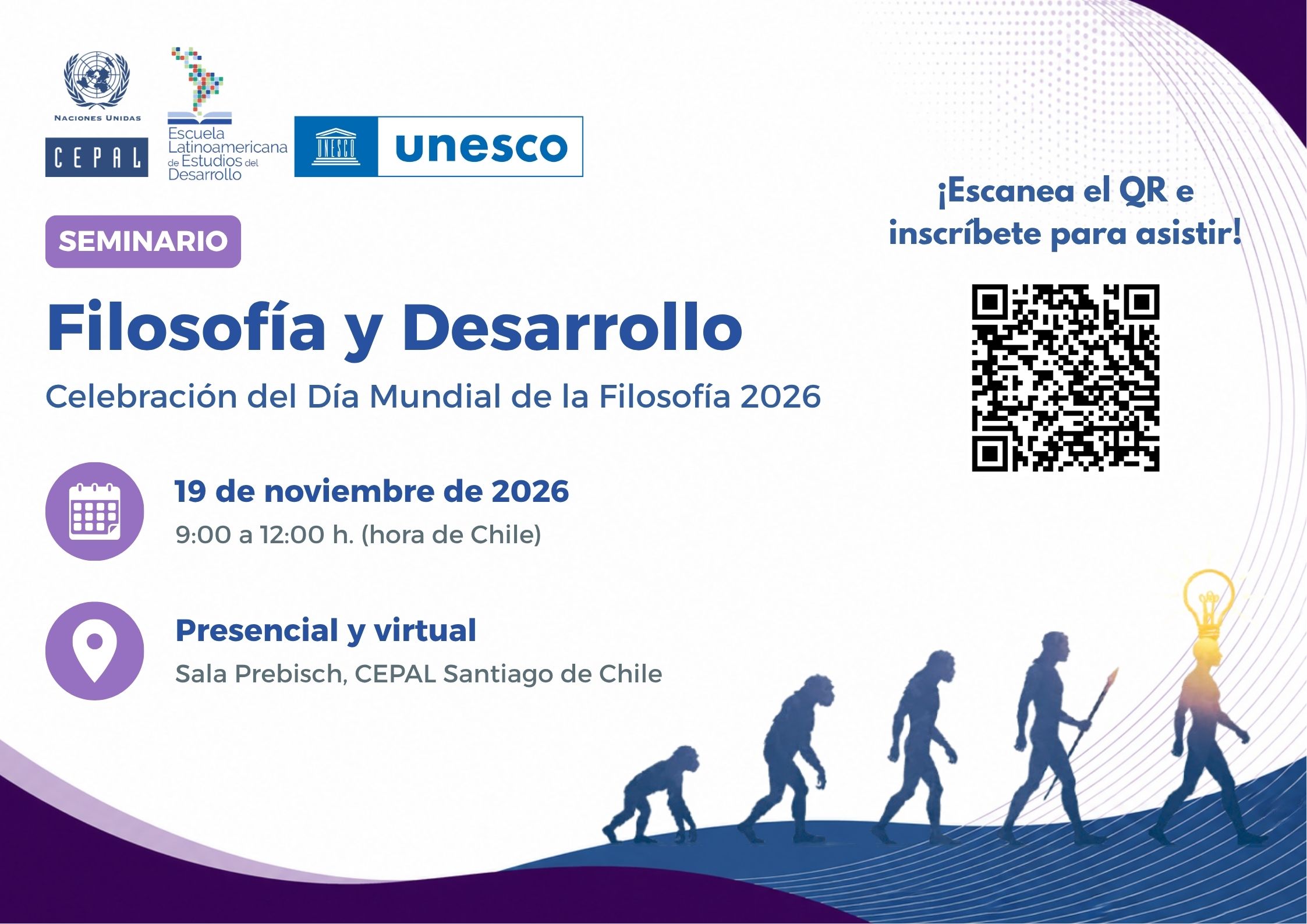
This seminar is held as part of the celebration of World Philosophy Day, introduced by UNESCO in 2002 and officially proclaimed by its General Conference in 2005, which is celebrated every year on the third Thursday of November. In establishing it, UNESCO recognized philosophy as a discipline that fosters critical and independent thinking, dialogue between cultures and the search for rational answers to humanity’s great challenges, and highlighted its contribution to peace, tolerance and mutual understanding among peoples. This vocation fully coincides with the purpose of this meeting: if development is, as has been argued, a category laden with ethical, epistemological and political assumptions that should be made explicit and examined, then philosophical reflection is not an ornamental complement to development studies, but a condition of their rigour and of their orientation towards human well-being and flourishing. Celebrating World Philosophy Day from Latin America and the Caribbean, and from institutions devoted to development, is a way of affirming that thinking about ends is as necessary as designing means.
This seminar has been jointly organized by the Latin American School of Development Studies (ELADES) of the Economic Commission for Latin America and the Caribbean (ECLAC) and UNESCO, and aims to provide a space for interdisciplinary reflection on the philosophical foundations of development, linking the ethics, epistemology and political philosophy of development with contemporary debates on its dimensions and measurement.