Justification
As digital technologies evolve, new forms of gender-based violence are emerging, requiring collaborative action to promote awareness, prevention and safer online spaces.
Across the Caribbean, violence against women and girls remains a persistent challenge that continues to undermine women’s rights, autonomy and participation in society. While countries have made important advances in legislative and policy frameworks to address gender-based violence, significant gaps remain in understanding and responding to emerging forms of violence occurring in digital environments. Limited evidence and insufficient data on online gender-based violence (OGBV) constrain the ability of policymakers, institutions and service providers to fully assess its prevalence, impacts and pathways for prevention and response.
As digital technologies become increasingly embedded in everyday life, women and girls are facing new forms of harassment, intimidation and abuse online. These manifestations include cyberstalking, technology-facilitated harassment, non-consensual dissemination of intimate content, hate speech and AI-enabled forms of abuse. Importantly, online gender-based violence should not be viewed as separate from other forms of violence against women. As highlighted in ECLAC’s Femicidal Violence in Figures Bulletin, online gender-based violence is linked to other forms of violence and to its most extreme expression, femicide, reflecting a continuum of discrimination and violence that can begin online and escalate offline, and vice versa. Understanding these links is essential for developing comprehensive responses that ensure justice, protect survivors and end impunity.
The proposed Caribbean Partnerships Space provides an opportunity to bring together governments, national statistical offices, mechanisms for the advancement of women, civil society organizations, academia, youth groups, development partners and technology stakeholders to advance dialogue on this emerging challenge. Through knowledge exchange and collaboration, the initiative seeks to strengthen capacities in the measurement of gender inequalities, statistical analysis and the use of gender equality indicators, including those promoted through the Gender Equality Observatory for Latin America and the Caribbean.
The initiative recognizes that effectively addressing online gender-based violence requires stronger evidence generated through official statistics, administrative records and dedicated research efforts. By creating a platform for dialogue and exchange, the Partnership Space will contribute to identifying innovative approaches to measuring, documenting and understanding technology-facilitated violence against women and girls. In doing so, it will support regional efforts to develop evidence-based public policies, strengthen institutional responses, improve survivor protection mechanisms and advance accountability frameworks aligned with the objective of ending violence against women and girls in all its forms.
As the inaugural public engagement activity for the proposed ECLAC Caribbean Partnerships Space, this initiative will demonstrate how the space can serve as a platform for knowledge exchange, partnerships and dialogue around emerging development issues. We will engage a range of partners and ensure that the Caribbean Partnerships Space has presential and online activity to expand the reach and impact.
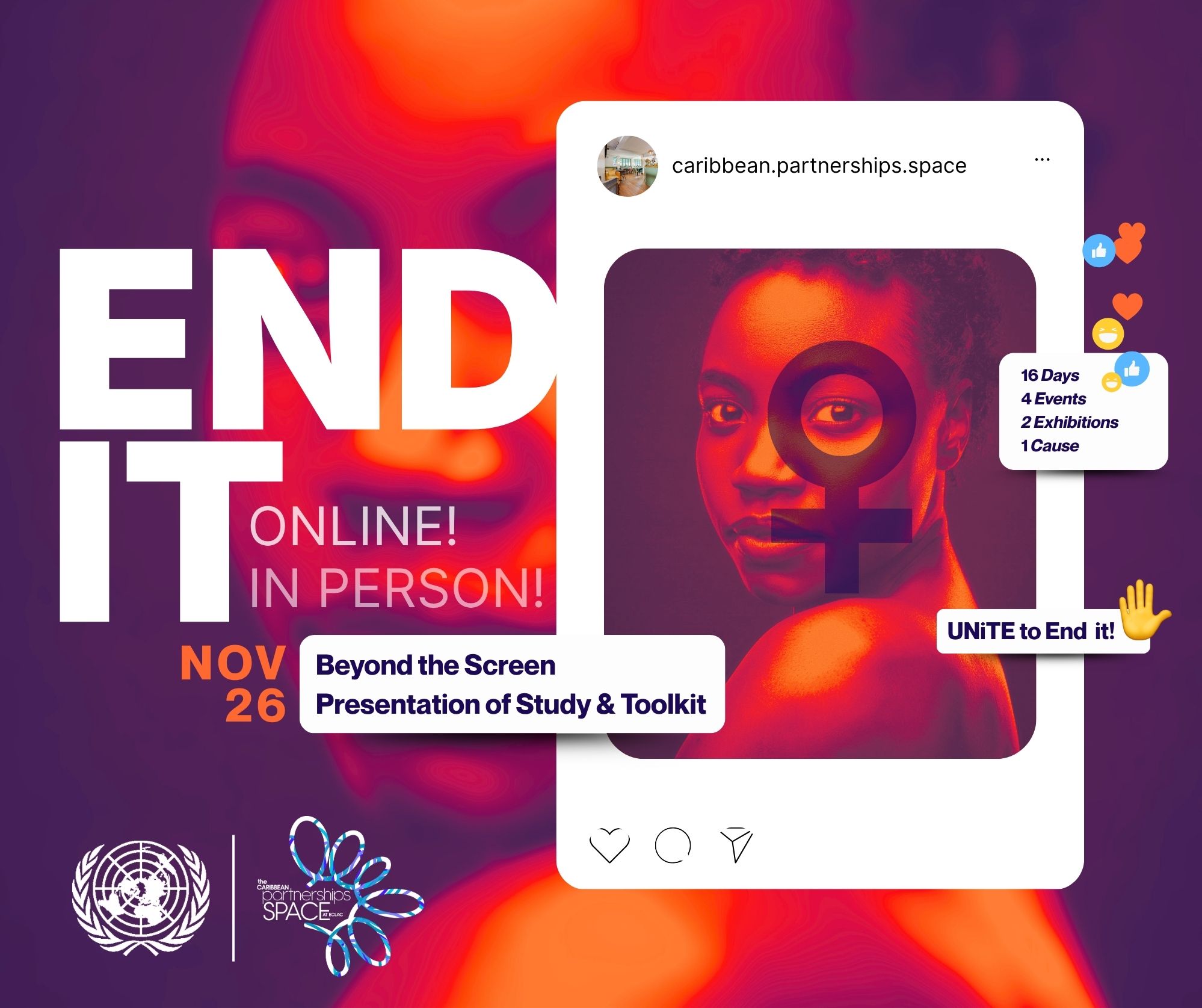
Held during the United Nations' 16 Days of Activism against Gender-Based Violence, the exhibition will focus on Online Gender-Based Violence (OGBV), an increasingly significant challenge affecting women and girls across the Caribbean. The exhibition will explore how digital technologies, social media and artificial intelligence can be used to harass, intimidate and exploit women, while also highlighting practical solutions for prevention, protection and digital resilience.
Rather than a traditional exhibition, the initiative will combine an interactive exhibition that remains open throughout the 16 Days with a series of selected events and activities. Visitors will be encouraged to explore, participate and reflect on the different forms and impacts of online gender-based violence, while engaging with practical tools and evidence-based information.
Background
Thirty years after the adoption of the Beijing Declaration and Platform for Action, violence against women and girls remains one of the most pervasive human rights violations and one of the greatest obstacles to achieving substantive gender equality. Despite significant progress in legal frameworks, institutional arrangements and public policies across Latin America and the Caribbean, gender-based violence continues to affect the physical, economic and decision-making autonomy of women and girls. The persistence of high levels of violence, including femicide and feminicide, demonstrates the need for renewed efforts to strengthen prevention, access to justice, survivor protection and accountability mechanisms.
At the same time, rapid advances in digital technologies are creating new contexts in which gender-based violence occurs. While technological innovation offers significant opportunities for inclusion and empowerment, it has also facilitated new forms of violence, harassment and abuse targeting women and girls. Online gender-based violence presents a growing challenge for governments and institutions, not only because of its expanding scale and complexity, but also because of the limited availability of data, statistics and evidence necessary to inform public policy responses. Building stronger evidence ecosystems is therefore essential to ensure justice, protect survivors and end impunity in relation to these emerging forms of violence.
For more than five decades, the Economic Commission for Latin America and the Caribbean (ECLAC) has supported Member States in advancing gender equality through regional cooperation, evidence generation and public policy development. Most recently, Member States adopted the Tlatelolco Commitment during the XVI Regional Conference on Women in Latin America and the Caribbean, establishing a Decade of Action (2025–2035) to accelerate the achievement of substantive gender equality and the care society in the region. The Commitment calls upon United Nations entities to accelerate efforts to end violence against women and girls and to join the Secretary-General’s UNiTE to End Violence against Women campaign. It further calls for the establishment of a working group on the implications of emerging digital technologies, including artificial intelligence, for gender equality in Latin America and the Caribbean, with particular attention to digital governance, women’s digital inclusion and technology-facilitated gender-based violence.
The Tlatelolco Commitment builds upon the broader Regional Gender Agenda and reinforces the importance of strengthening evidence-based policymaking. In this regard, the Gender Equality Observatory for Latin America and the Caribbean, established at the request of the region’s countries through the Quito Consensus (2007), has become a key regional mechanism for strengthening the capacities of national mechanisms for the advancement of women and national statistical offices. The Observatory compiles, updates and disseminates strategic indicators on gender equality, including indicators on femicide and women’s participation in decision-making, thereby supporting the monitoring of regional and international commitments. As online gender-based violence emerges as a growing policy concern, generating evidence through official statistics, administrative records and dedicated studies becomes increasingly necessary to understand its prevalence and impacts and to support effective policy responses.
As highlighted by ECLAC’s Femicidal Violence in Figures Bulletin, online gender-based violence against women is linked to other forms of violence and to the most extreme manifestation of gender-based violence, femicide. It reflects a continuum of discrimination and violence that can originate in digital environments and lead to violence offline, while offline violence can also extend into online spaces. Recognizing and documenting these interconnections is essential for the development of comprehensive strategies that address violence against women and girls across all dimensions of their lives.
Online gender-based violence (OGBV) is an increasingly important dimension of gender-based violence in the Caribbean, as growing digital connectivity creates new avenues for harassment, intimidation and abuse. It can take many forms, including cyberbullying, cyberstalking, online harassment, doxxing, non-consensual sharing of intimate images and AI-enabled abuse such as deepfakes. In the Caribbean, emerging evidence points to risks for women in public life, including politicians, journalists, activists and community leaders, who may face sustained online attacks that can affect their safety, wellbeing and willingness to participate in public life. At the same time, limited region-specific data and gaps in legal and institutional responses can make these forms of violence difficult to prevent and address effectively. Addressing OGBV therefore requires stronger evidence, public awareness, digital literacy, survivor-centered support and coordinated action across governments, civil society, technology platforms and the wider Caribbean community.
Objective
To convene partners and the public in a collaborative learning and dialogue space that advances understanding of the continuum of violence against women and girls, from femicide to online gender-based violence, while promoting knowledge exchange and partnerships that contribute to prevention, survivor protection, justice and accountability
Partners
ECLAC Caribbean together with ECLAC Gender Affairs Division will seek to collaborate with: UN System in the subregion including the UNRCOs and agencies like UNIC, UNFPA, UN WOMEN, Regional Partners like CARICOM, OECS also European Union Delegation in Port of Spain, Embassy of Spain, National Statistical Offices, academics and civil society organizations.