Latin America and the Caribbean strengthen cooperation in transboundary waters: trust, dialogue, and solid institutional frameworks
Work area(s)
Topic(s)
Within the framework of the Fifth Regional Water Dialogues for Latin America and the Caribbean, the International Seminar on Transboundary Waters, "Strengthening the Governance of Transboundary Water Resources in Latin America and the Caribbean: Regulatory Frameworks, Agreements, and Climate Adaptation," was held on October 8 and 9, 2025, at ECLAC headquarters in Santiago, Chile.
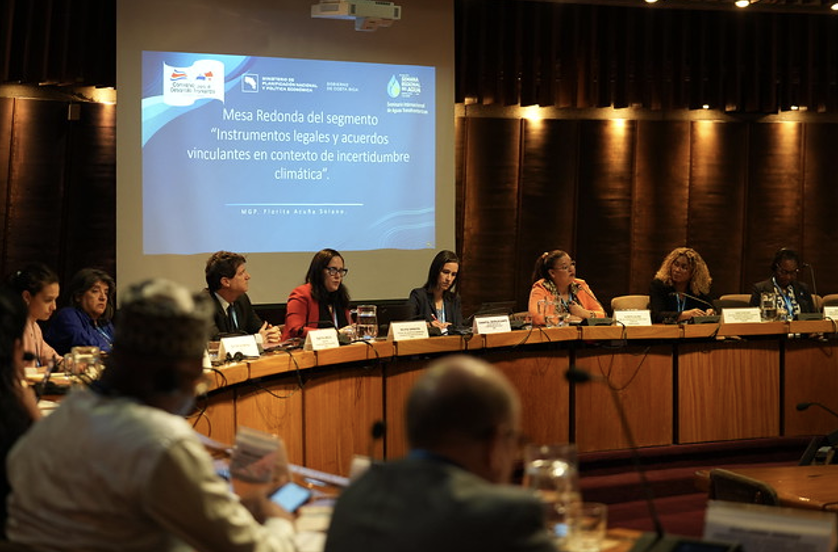
The meeting, organized by the Economic Commission for Latin America and the Caribbean (ECLAC) together with the Government of Chile, the United Nations Economic Commission for Europe (UNECE), and UNESCO, brought together government representatives, international organizations, academics, and civil society with the aim of strengthening regional water cooperation, promoting integration, and sharing experiences on the sustainable management of shared waters.
The seminar took place over two days. The first, on October 8, consisted of a closed technical meeting aimed at sharing experiences on governance, regulatory frameworks, and institutional frameworks for cross-border cooperation.
The second day, held on October 9, was open to the public and addressed the main advances, challenges, and opportunities in cooperation and investment in transboundary waters, highlighting the importance of strengthening regional governance, promoting sustainable management, and fostering inclusive participation in shared water resources in Latin America and the Caribbean.
Opening and context
The session was moderated by Martín Abeles, Director of ECLAC's Natural Resources Division, and featured welcoming remarks by Gloria de la Fuente, Undersecretary of Foreign Affairs of Chile, and Luis Fidel Yañez, Secretary of the ECLAC Commission.
who highlighted the commitment of the Government of Chile and ECLAC to strengthening regional dialogue and multilateral cooperation around shared water.
Next, Soraya Salcedo, Deputy Director of the International Cooperation Unit of Peru's Ministry of Agrarian Development and Irrigation, presented the main results of the 4th Symposium on Transboundary Basins in Latin America and the Caribbean, held the previous week.
Next, Silvia Saravia Matus, Economic Affairs Officer and Head of Water Resources at ECLAC, presented the regional progress on SDG 6.5.2, which measures the degree of operational cooperation in transboundary basins. She explained that, beyond the existence of agreements, the indicator assesses their effectiveness, the quality of information exchange, and institutional sustainability.
The regional analysis shows a positive trend, with a growing number of countries reporting information and strengthening their joint cooperation mechanisms. However, challenges remain related to legal alignment, the availability of technical and financial resources, and coordination between different levels of government. The Official emphasized that effective cooperation requires strong institutions, sustainable resources, and inclusive participation of communities, Indigenous peoples, and civil society. She emphasized that "an agreement does not guarantee cooperation; the difference is made by institutions, resources, and political will."
As part of this work, ECLAC classified the main difficulties faced by transboundary water agreements in order to better understand the nature of the obstacles to their implementation. Five main categories were identified. The first, operational-legal alignment, groups together challenges related to harmonizing agreements with national and regional legislation. The second, operational-capacity and resource, encompasses financial, human, and technical constraints that affect the effective implementation of commitments. A third category combines both legal and capacity dimensions, reflecting agreements that simultaneously face normative and institutional challenges. The fourth, mixed-political-operational, encompasses cases in which diplomatic tensions or the lack of full participation by some coastal States combine with legal or resource constraints. Finally, agreements without significant reported difficulties were identified, that is, those that countries consider do not face substantive obstacles to their implementation.
The analysis shows that most agreements present combined challenges, highlighting the need to strengthen both legal alignment and institutional and technical capacities. Financial, human, and technological constraints remain a recurring problem, and many legal instruments are limited or outdated, lacking full coherence with national or regional frameworks. Furthermore, differences were observed between countries participating in the same agreement, highlighting differing perceptions of the challenges and reinforcing the need to improve coordination and joint dialogue.
Overall, the results confirm that SDG 6.5.2 not only measures the existence of agreements, but also their actual functioning, and that its main value lies in strengthening practical, coherent, and sustainable cooperation in shared water management in Latin America and the Caribbean.
Finally, Francesca Bernardini, Head of the UN/ECE Transboundary Cooperation Section, offered a summary of the previous day's discussions, highlighting why cooperation on shared waters is so important: because it sustains economic growth, reduces conflict risks, and increases resilience to climate change. She emphasized that transboundary cooperation is not only about managing natural resources, but also about building strong institutions and promoting regional integration, especially in territories where populations live far from decision-making centers.
He also highlighted the central role of international water law and the United Nations Water Convention, which provide a common framework to guide countries' actions. He noted that clear, widely known and respected rules generate predictability and trust, and that many of the Convention's provisions, such as information sharing, early warning, and scientific cooperation, are concrete tools for building and maintaining that trust.
First session: Institutional mechanisms and cross-border governance arrangements
The first session of the day, moderated by Chantal Demilecamps, Environmental Affairs Officer, Secretariat of the United Nations Water Convention (UNECE), addressed the topic "How institutional mechanisms build the framework for cooperation."
The session was the first part of the day's work, which combined the presentation of specific experiences in Latin America and Africa with comparative academic reflection and a roundtable discussion between representatives from different countries.
The exchange began with the experience of Costa Rica and Panama, presented by Florita Acuña Solano, from the International Cooperation Area of MIDEPLAN (Costa Rica), and Yarid Guevara, Head of the Integrated Watershed Management Department of the Ministry of Environment (Panama).
Together, they presented the progress of the Binational Commission of the Sixaola River Basin, a well-established example of cross-border territorial cooperation that promotes sustainable development and participatory management on the border between the two countries.
They explained how the Commission has enabled policy coordination, information sharing, and trust building over the years.
Among its achievements were joint monitoring of SDG 6.5.2, shared studies on aquifers and water management, and technical exchange and joint project planning for the benefit of border communities.
The Sixaola experience shows that effective cooperation requires both political will and flexible institutional frameworks capable of adapting to different local realities and promoting the active participation of civil society, not just national authorities.
From West Africa, Bernadette Adjei, Director of the Legal and Monitoring Department of the Ghana Water Resources Commission, presented the African regional experience in cross-border cooperation.
He explained that the region has a regional water resources policy and a common directive on water management in West Africa, which has enabled the development of shared agreements and projects between neighboring countries.
He highlighted the creation of a joint system for exchanging hydrometeorological and early warning data, coordinated by national technical committees, as well as the promotion of shared use of infrastructure to avoid duplication and optimize resources.
Adjei emphasized that institutional strengthening at the local level, along with public awareness and the participation of all social stakeholders, are essential elements for maintaining active and effective cooperation. He also noted that economic cooperation platforms and regional financing mechanisms are key to the sustainability of these agreements.
Finally, he emphasized that West African countries are using the instruments of the UN Water Convention to strengthen cooperation at the basin level, applying its principles and tools in practice.
Daniela Rivera, Professor at the Faculty of Law and member of the Center for Water Law and Management at the Pontifical Catholic University of Chile, focused her presentation on the challenges of continuity and sustainability of cross-border cooperation.
He stressed the need to maintain inter-institutional coordination, especially when it comes to agreements involving multiple countries, and to ensure stable financing that allows for sustained action over time.
He stressed the importance of strategic planning, clear legal and institutional mechanisms, and the effective and meaningful participation of all stakeholders.
He recalled that water is a powerful tool for building peace, but also for maintaining it, provided there is political will and solid structures to support cooperation.
In the final part, the roundtable brought together Juan Saldaña, Director of Planning for Institutional Development, National Institute of Hydraulic Resources, Dominican Republic; Ana Carolina Argolo Nascimento de Castro, Director of the National Agency for Water and Basic Sanitation, ANA, Brazil; and Rodrigo Sanhueza Bravo, Director General of Water, Ministry of Public Works, Chile, who reflected on the obstacles and enabling factors for cross-border cooperation.
In the roundtable discussion on obstacles and enabling factors for cross-border cooperation, participants offered complementary perspectives from their national contexts.
Juan Saldaña (Dominican Republic) highlighted that one of the main challenges is the lack of clear interlocutors between countries, which hinders communication and the continuity of agreements. He noted that academia can play a key role as a bridge to understanding and stressed the importance of countries clearly defining the purpose of the cooperation: "Why do we want to reach an agreement?" he noted, "because sometimes the reason for it isn't clearly understood or evident." He also praised the support provided by international cooperation agencies through concrete accompaniment mechanisms.
From Brazil, Ana Carolina Argolo Nascimento de Castro emphasized that the main challenges lie in institutional strengthening and the availability and sharing of information, especially regarding transboundary aquifers. She emphasized that there are still difficulties in shared management, as well as a gap in data generation and technical training, particularly in downstream areas.
For his part, Rodrigo Sanhueza Bravo (Chile) emphasized that climate change is a central challenge for cooperation, as it requires synergies and agreements beyond administrative boundaries. He indicated that, while collaboration agreements exist, many lack an explicit cross-border framework, and proposed learning from the experiences of other countries, since "water transcends borders" and its joint management can strengthen regional cooperation.
The conversation then turned to the question, "What does the region need to advance cooperation?"
Among the topics that emerged, the need to assume shared responsibility for water management and to strengthen political and institutional commitment to tangibly transform people's lives stood out.
The importance of creating spaces for exchanging experiences that generate new ideas and strengthen management capacities was emphasized, as well as maintaining regional stability, given that conflicts between countries can have broader impacts.
Participants agreed that progress requires greater dialogue between sectors and stakeholders, greater transparency and monitoring of agreements, and an effort to place water at the center of the political agenda. They also proposed establishing a common agenda with defined timelines, sharing knowledge, and strengthening the role of national focal points as a bridge between the technical and decision-making levels.
Second session: Legal instruments and binding agreements in contexts of climate uncertainty
The second session of the day, entitled "Legal Instruments and Binding Agreements in Contexts of Climate Uncertainty," was moderated by Giovanna Valverde Stark, Head of the Department of Sovereignty, Limits and Borders and Climate Change Advisor at the Ministry of Foreign Affairs of Costa Rica.
The debate focused on how to ensure that water cooperation agreements are sustained over time, both politically and institutionally, as well as financially and operationally.
The session opened with a presentation on the case of Lake Titicaca by Marissa Castro Magnani, Director General of Limits, Boundaries, and International Transboundary Waters of the Plurinational State of Bolivia, who explained how cooperation between Peru and Bolivia is articulated through the Binational Autonomous Authority of Lake Titicaca (ALT).
Castro Magnani emphasized that all financial and operational aspects of the ALT are approved by the foreign ministries of both countries, guaranteeing its legitimacy and sustainability. He emphasized that each country has national liaison committees responsible for coordinating actions with the binational organization, which has allowed for maintaining active cooperation for decades and developing joint projects in environmental monitoring, water quality management, and local development.
Subsequently, K. Armand Houanye, Executive Secretary of the Niger River Authority (NBA), shared the Authority's experience and its operations. He explained that the NBA has established legal and technical instruments, including standards on coordinated dam management, prior notification of measures with potential impacts, and equitable benefit-sharing. He emphasized that the principle of equitable and reasonable use of water constitutes the basis of cooperation among the nine member countries, and that access to climate and development funds has been essential to maintaining joint programs over the long term.
Guillermo Donoso, Professor at the Faculty of Agronomy and Natural Systems and Director of the Center for Water Law and Management at the Pontifical Catholic University of Chile, then offered a special address, highlighting the commonalities between the experiences of Lake Titicaca and the Niger River. He emphasized that both cases reflect the importance of stable institutional structures, clear financing mechanisms, and participatory governance that combines technical, political, and community work.
Finally, a roundtable discussion was held with the participation of Florita Acuña Solano (MIDEPLAN, Costa Rica), Oscar Puerta Luchini (Director of Integrated Water Resource Management, Ministry of Environment and Sustainable Development, Colombia) and Giovanny Melgar Hernández, General Coordinator of the National Agreement and International Cooperation CONAGUA, Mexico.
During the exchange, different approaches were discussed regarding the factors that enable cooperation to be sustained over time. It was noted that climate change policies must be considered state policies, not government policies, ensuring their continuity beyond political cycles.
The panelists highlighted the importance of intersectoral coordination, participatory management, and strengthening protocols and technical capacities to support bilateral agreements. They also emphasized that a strong national, institutional, and legal foundation enables the development of better international cooperation, and that countries must continue to move toward greater policy harmonization and fluid dialogue between experts, legal experts, and decision-makers.
One of the most discussed points was the need to build sustainable capacity over time. The creation of a regional training school was proposed, aimed at strengthening the skills of national representatives to access financing, implement projects, and generate lasting learning.
Likewise, the creation of a regional steering committee was proposed to promote regular meetings, foster the exchange of experiences, and ensure ongoing monitoring of agreements. Participants agreed that information and knowledge must remain in local territories and communities, so that cooperation directly contributes to their development. Finally, it was emphasized that legislation must be built from the bottom up, involving communities in its design and ensuring that standards do not remain "in the library" but are translated into concrete practices.
The session concluded by highlighting that institutional mechanisms not only frame cooperation, but also sustain and enable it. International water law and the Water Convention can facilitate the development and implementation of such agreements and projects, ensuring their equity and long-term sustainability. Where stable structures, clear rules, and a willingness to engage in dialogue exist, countries can move toward stronger, more resilient, and lasting agreements.
Related content
Regional Water Week for Latin America and the Caribbean – Santiago, Chile 2025
The Economic Commission for Latin America and the Caribbean (ECLAC), together with the Conference of Ibero-American Water Directors and Authorities (CODIA) and the Government of Chile, through the…