Day 2 | Regional Water Dialogues 2025 LAC - Session 3 — Water and Agriculture: Solutions for Water Availability and Land Tenure Governance in LAC
Work area(s)
Topic(s)
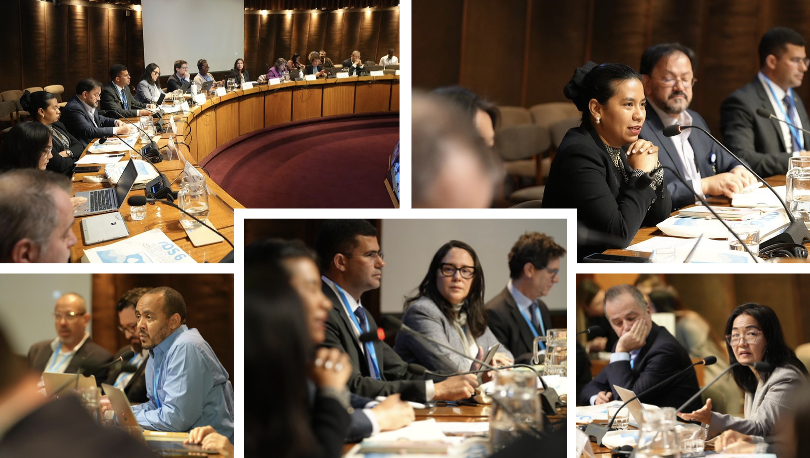
The panel began with ministerial interventions from Honduras and Brazil, who addressed topics ranging from planning to the impact on the territory.
Honduras emphasized that irrigation must be a state policy and a lever for national food sovereignty . Meanwhile, Brazil indicated that the expected outcome is to achieve water security with social legitimacy and endogenous financing, all aligned with a value-added development agenda .
Minister Laura Suazo highlighted the country's "water paradox"—an abundance of resources with low utilization for irrigation—and presented a 20-year agri-food policy that articulates institutional strengthening, inclusive financing, and marketing, with irrigation as the cornerstone for productivity and resilience . The roadmap is operationalized through a National Irrigation and Drainage Master Plan (diagnostic phase with CIAT and second phase with CAF), which maps surface and underground sources, prioritizes zones and typologies, and corrects decades of fragmented planning. In parallel, rapid implementation programs (motors/pumps and transmission lines) already connect thousands of producers and more than 1,000 hectares, showing early results. Suazo highlighted public-private and international partnerships and a regional coalition to accelerate investment, modernization, and value-added. She emphasized that "Without water, there is no food security or sovereignty"; the cost of the resource must be internalized in the chains, and irrigation must be scaled as a priority in the face of climate variability.
Brazil's National Secretary for Water Security, Giuseppe Serra, presented a comprehensive strategy that combines large-scale projects (e.g., the transposition of the São Francisco River and projects reactivated through the New PAC ) with local solutions such as massive cistern programs and the "Agua Dulce" (Sweet Water) program to desalinate saline groundwater with community co-management. Governance operates on a dual scale (federal/state) coordinated by ANA, with outorgas and usage fees reinvested in watersheds through more than 230 committees , and sustainable irrigation that prioritizes family farming with differentiated credit. The expected result is to achieve water security with social legitimacy and endogenous financing , translating water into employment, productivity, and reduced inequalities.
He mentioned that the gap between the flow granted and the actual use in federal basins reveals optimization potential of >1,000 m³/s , while >1,200 freshwater systems already serve thousands of rural families.
For his part, Adrián Rodríguez, Head of ECLAC's Agricultural Development Unit, who led the segment, closed the segment, underscoring the need for evidence-based policies and multilevel coordination to translate investment into agricultural productivity and territorial resilience .
Panel - Strengthening Water Governance through Tenure: Experiences and Challenges in LAC
The session, moderated by Amparo Cerrato, FAO Land Tenure and Natural Resources Officer for LAC, opened with a sense of urgency: more than 733 million people are currently living under severe water stress , a situation already experienced by the region with unprecedented droughts in Uruguay and Mexico , and critically low reservoir levels in Chile and Colombia . In this context, water is crucial for food security : according to the FAO, agricultural production is expected to grow by 50% by 2050 , while agriculture accounts for 72% of freshwater withdrawals . Protecting and governing this resource is therefore an urgent priority .
FAO led this regional panel as part of its Dialogue on Water Tenure , aimed at identifying approaches and principles for responsible governance that reflect the realities of Latin America and the Caribbean and feed into the Global Dialogue in Rome , the outcomes of which will be presented at the UN Water Conference (UAE, December 2026) . The operational objective was clear: to collectively reflect on formal and informal allocation frameworks , and to build shared criteria that support public policy decisions with social legitimacy and technical effectiveness.
Maya Takagi, FAO's Programme Director for the region , highlighted the scope of the process: national assessments and dialogues (including Colombia) and a dedicated regional dialogue in 2025 , always with a core conviction: "As FAO, we are committed to enabling spaces for consensus-building on water tenure and governance, promoting partnerships and synergies between stakeholders . " Effective governance must involve real participation, include clear rules, and rely on multi-stakeholder cooperation .
Representatives from the Latin American and Caribbean Parliament (Parlatino) , the Colombian Ministry of Environment and Sustainable Development , the Trifinio Women's Network HOSAGUA (Honduras, El Salvador, and Guatemala) , and CITAFRO (International Coalition of Organizations for the Defense, Conservation, and Protection of the Territories of Afro-descendant Peoples in LAC) participated in the panel. Their messages highlighted the institutional and territorial diversity—legislature, central government, women's networks, and Afro-descendant organizations—that provides legitimacy and sustainability to the agreements .
FAO’s institutional commitment is anchored in a clear roadmap, established in 2022 , where the Committee on Agriculture ( COAG) recommended developing the Global Dialogue on Water Tenure , launched in 2023 at the UN Water Conference (New York) . Since then, the issue has been given top priority . The FAO Conference adopted “Water resources management for the four bets” (better production, better nutrition, better environment and better lives) as the 2024–2025 biennial theme , and COAG 29 (2024) reaffirmed it as one of the five accelerators of SDG 6 and a pillar of FAO’s new Conceptual Framework for integrated land and water management . As a result , the principles of responsible governance for water tenure , a product of the Global Dialogue, are expected to be elevated to the Committee on World Food Programme (CFS) in the 2028–2032 plan .
Finally, the panel delivered three cross-cutting messages. First , tenure-based water governance is a systemic enabler for closing access and allocation gaps in contexts of increasing water stress. Second , the path is both political and technical : clear regulatory frameworks, recognition of local arrangements, and effective participation mechanisms . Third , sustainability depends on lasting partnerships : parliaments, ministries, women's networks, and Afro-descendant organizations must co-create principles and tools that can be scaled regionally and align with the global agenda leading up to 2026 .
Panel - Nature-Based Solutions: Innovation for Water Security in LAC Agriculture
The session, moderated by IICA consultant Alba Llavona, opened with a presentation by Hombray Taylor, Coordinator of IICA's Hemispheric Initiative on Water and Agriculture , who delivered a regional assessment: 74% of the water withdrawn in LAC is used for agriculture in a context of limited efficiency and increasing climate pressure. His central message was forceful: “without water, there is no agriculture or food security .” As a structural response, he presented IICA's strategy, structured around four axes— water production and storage with NBS , irrigation efficiency and digitalization , participatory governance with the producer at the center , and investment promotion (including PES )—emphasizing that NBS are not marginal pilot projects, but rather practical and scalable solutions . He supported this approach with an active portfolio of 21 projects in 15 countries (~US$50 million) aimed at strengthening local capacities and producing evidence of impact on productivity, resilience, and water sustainability.
The experience exchange began with Wilson Ureta, Executive Director of Chile's National Irrigation Commission (CNR) , who explained the legal reform that explicitly incorporated NBS as eligible irrigation projects . In a field where they compete with gray infrastructure of known cost-benefit, Chile has provided subsidies of up to 95% when sustainability is proven , and consolidated a national technical panel for training and evaluation. The key message of his intervention was that NBS compete and scale when there is an enabling framework, clear rules, and well-designed public financing .
From the Dominican Republic , Juan Saldaña, Director of Institutional Development Planning at INDRHI , detailed the progress made in the Yaque del Norte watershed , where a private-sector-led water fund is promoting shade-farmed production, direct aquifer recharge, and crop rotation , involving producers, livestock farmers, and agro-industries. He noted that the challenge is not only physical but also institutional: water governance and distribution . His driving force: the integration of gray, green, and blue infrastructure, coupled with multi-stakeholder synergy, is crucial for sustainable results .
With a regional perspective, Alejandro Calvache, leader of The Nature Conservancy's (TNC) Resilient Watersheds strategy for Latin America , called for thinking beyond the property and managing at the landscape scale , incorporating glaciers, forests, and peatlands that regulate downstream flows. He warned that NBS require long-term financing, scientific evidence, and local knowledge , and proposed involving finance ministries to make their scaling viable. Its core: landscape perspective + patient financing = sustainable and replicable NBS .
For her part, Gena Gammie (Forest Trends) presented the experience of Peru , where investments in natural infrastructure —high Andean restoration, wetland improvement, and spring conservation—have been institutionalized, demonstrating that agricultural productivity and sustainability can be aligned . She highlighted that, alongside cooperation, replicable local economic incentives are emerging , which anchors her main message: institutionalization and local incentives create lasting traction for NBS.
Ángela Penagos, Director of the ECLAC Office in Colombia , explained the tensions between traditional agricultural policies and the incorporation of NBS in a context without an official definition or unified national policy . She emphasized that development credit for water solutions does not exceed 5% , which hinders adoption and scale. Her emphasis was clear: intersectoral coherence and explicit financial signals are needed to unlock investment in NBS .
Finally, the closing of all the blocks was led by Bernadette Adjei, Director of the Legal Department of the Ghana Water Resources Commission , and Monica Rodrigues, Economic Affairs Officer at ECLAC . They highlighted the three enabling conditions for moving from experiences to a systemic transformation: participatory territorial governance , applied science with monitoring that proves the cost-benefit ratio , and long-term financial mechanisms —from PES and water funds to combined schemes—that provide stability to investments. The note left by the session is unequivocal: NBS are a pillar for ensuring water and productivity in LAC agriculture , provided that they are built from the territory with the farmer at the center , have adequate regulatory frameworks and incentives , and are financed with horizons that allow their benefits to mature .
Related content
Regional Water Week for Latin America and the Caribbean – Santiago, Chile 2025
The Economic Commission for Latin America and the Caribbean (ECLAC), together with the Conference of Ibero-American Water Directors and Authorities (CODIA) and the Government of Chile, through the…
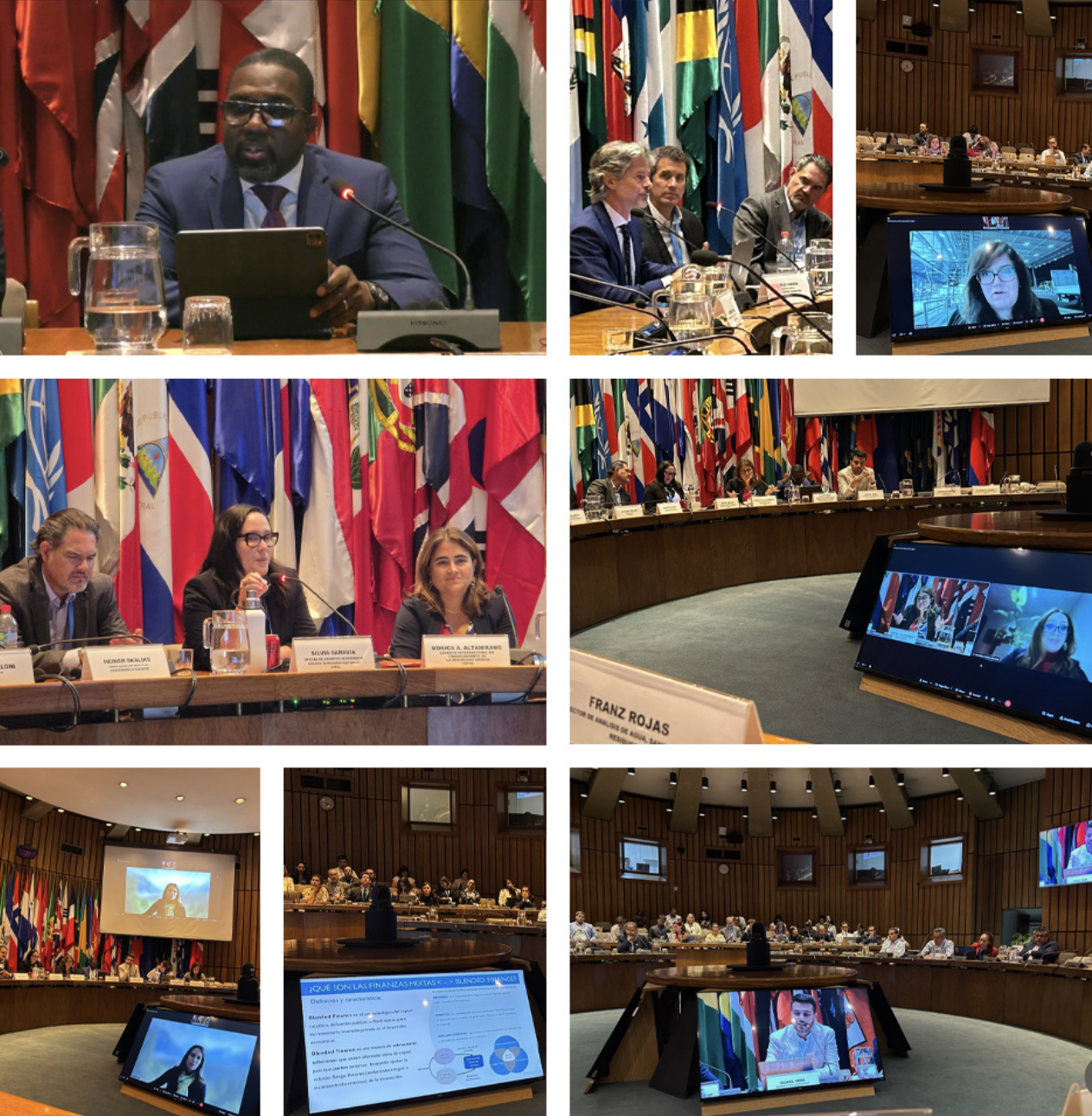
Session: Closing the Implementation and Financing Gap for Water Security in Latin America and the Caribbean – Regional Water Week 2025
During the 2025 Regional Water Week, ECLAC and its strategic partners convened the special session “Closing the Implementation and Financing Gap for Water Security in Latin America and the…