Session: Closing the Implementation and Financing Gap for Water Security in Latin America and the Caribbean – Regional Water Week 2025
Work area(s)
Topic(s)
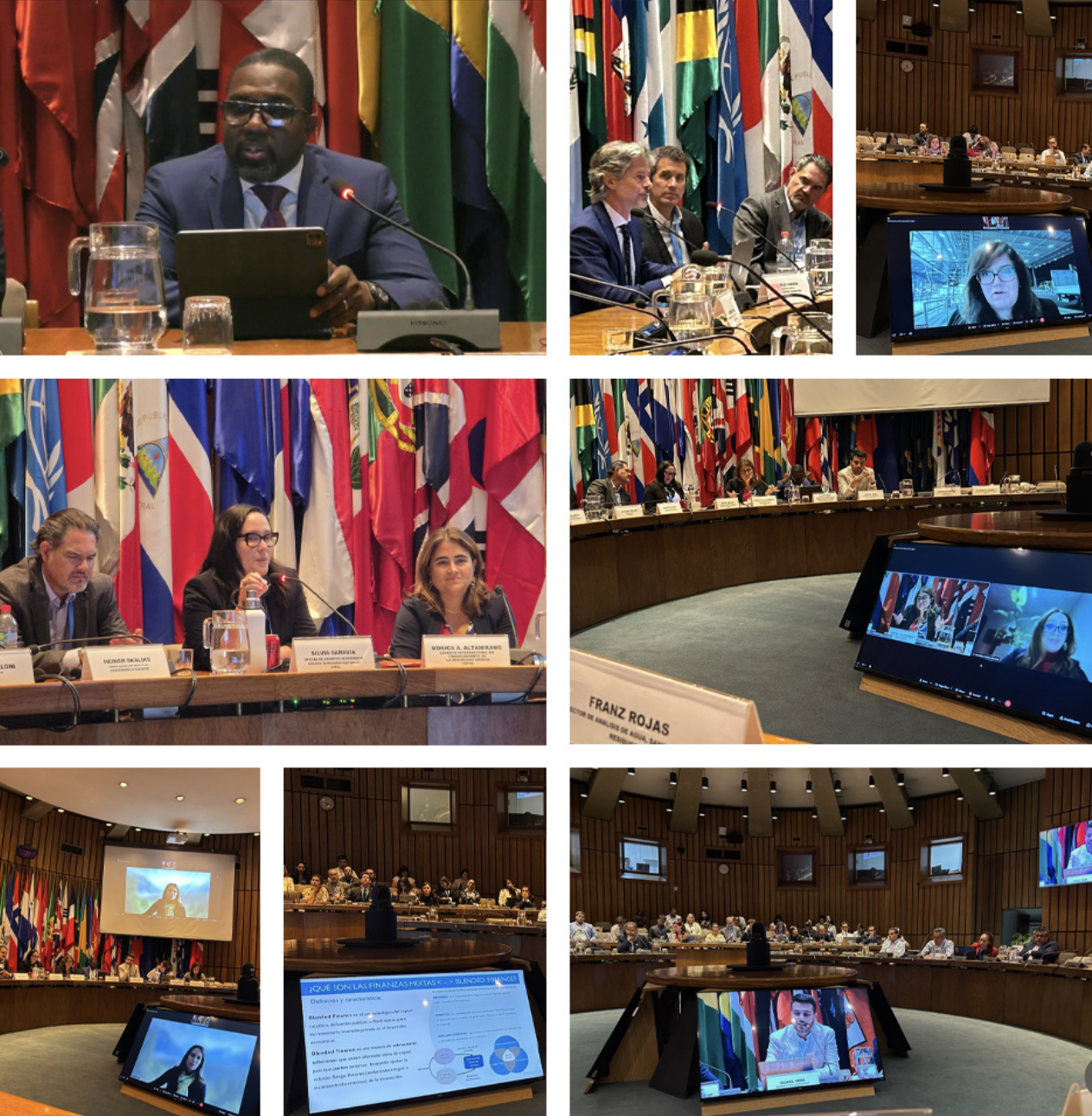
During the 2025 Regional Water Week, ECLAC and its strategic partners convened the special session “Closing the Implementation and Financing Gap for Water Security in Latin America and the Caribbean”, a dialogue space aimed at transforming the way we plan, structure, and finance investments in water and sanitation.
Introduction and General Purpose
The session, held on October 8 in a hybrid format, brought together more than 25 representatives from governments, development banks, utilities, philanthropic organizations, and civil society.
The starting point was clear: the region faces a double gap. On one hand, a financing gap that limits investment in water infrastructure; and on the other, an implementation gap, which prevents the effective execution of already-approved resources. According to estimates from the IDB and the World Bank, more than 28% of sector budgets remain unspent. The session therefore sought to identify mechanisms to strengthen institutional capacities and mobilize sustainable investments that translate plans into concrete action.
Over four hours, the dialogue not only highlighted emerging financial innovations in the region but also outlined a shared roadmap toward a new water-financing architecture, more systemic, inclusive, and performance-based.
Introductory Block: Integration, Investment, Inclusion, and Leverage Points
The opening block set the strategic tone for the entire session: moving from plans to action by closing the gaps between planning, financing, and implementation.
Mr. Alva Browne, Permanent Secretary of the Ministry of Infrastructure and Physical Development, Public Utilities, Civil Aviation and Transport of Grenada, opened the dialogue by reminding that water security “is not an abstract issue, but a reality that defines the resilience of our peoples.” His intervention strongly conveyed the urgency of moving from planning to execution in a context of hydroclimatic extremes, where droughts and floods alternate within the same year. Browne stressed that closing the implementation gap requires progress along three pillars: integration, investment, and inclusion.
Integration, because water must be managed as part of a national system connecting territory, energy, agriculture, and communities. In the Caribbean, he explained, the creation of the Water Resources Management Unit and the new Water Resource Management and Regulation Act in Grenada exemplify how to integrate watersheds, land use, and climate resilience within a unified legal and institutional framework.
Investment, understood not only as attracting funds but as smart and purposeful investment, where every dollar allocated to water generates tangible returns in productivity, resilience, and equity. In his words, “every investment must lead to impact.”
Inclusion, because water security must be built with and for people, integrating the voices of rural communities, women, youth, and historically marginalized groups. “Resilience is built by people, not just through projects,” he affirmed.
The block continued with the technical presentation by Dr. Silvia Saravia Matus, Economic Affairs Officer at ECLAC, and Dr. Mónica Altamirano de Jong, international expert in water security finance. They introduced the Water Security Financing Framework (WSFF), a methodological tool aimed at connecting sectoral planning with financial structuring and effective investment management.
Silvia Saravia Matus emphasized a central idea: the gap preventing water security is not only financial but also institutional and execution-related. In Latin America and the Caribbean, water and sanitation plans often identify priorities but rarely translate them into viable investment portfolios with defined costs, timelines, responsibilities, and repayment sources. In this context, the WSFF offers a bridge between planning and investment, turning strategic goals into fundable and sustainable portfolios.
The presentation outlined five key pillars—strategic, economic, financial, commercial, and management—to develop a complete business case for each water security investment. Through these pillars, projects become not only technically sound but also financially “investable,” and in some cases even “bankable.”
Mónica Altamirano expanded the discussion, noting how the global financial environment is reshaping the rules of the game. Today, she explained, “sustainability is no longer an ethical option, but a financial requirement.” New green taxonomies, environmental, social, and governance (ESG) regulations, and pressure from institutional investors require governments and operators to demonstrate performance and traceability of impact. This means that the architecture of water financing must be redesigned to seize the opportunities emerging from these standards and to leverage instruments such as thematic bonds, climate funds, and blended finance.
ECLAC’s proposed framework identifies three key leverage points for systemic change:
- Strengthening the capacity to prepare investments with financial logic, aligning bankable programs with clear financing strategies and solid implementation arrangements.
- Consolidating robust governance to reduce regulatory and execution risks and create incentives for investment and collective action at the watershed level.
- Designing effective implementation mechanisms, through performance-based contracts, sustainable repayment schemes, and smart procurement ensuring verifiable results.
Both speakers stressed the importance of developing institutional capacities—called TOPP capacities (Technical, Operational, Political, and Prospective)—as a structural condition for closing the implementation gap. These capacities, they noted, are the “silent but decisive component” behind any successful investment.
Their joint message was clear: the region does not need more diagnostics, but concrete mechanisms that turn planning into execution and financing into impact. This requires integrating policies, strengthening institutions, and rethinking how investments are identified and planned—from a mission-oriented, cross-sectoral approach—and how success is measured: not only in kilometers of pipelines or plants built but in resilience achieved, quality of life improved, and long-term financial sustainability ensured.
Roundtable 1. Impact Investment and Results-Based Financing Mechanisms
The first roundtable reflected the region’s growing maturity in financial innovation. Heiner Skaliks, from Convergence Blended Finance, explained that blended finance “is not an instrument but a mindset for structuring projects,” using catalytic capital to reduce risks and attract private investment.
Concrete examples confirmed this vision. Renato Moura, from Water.org, presented the Blue Bonds Program in Peru, implemented with COFIDE, mobilizing over USD 290 million to finance local water and sanitation projects, focusing on rural areas and women entrepreneurs. Antonella Laino, from Aguas Andinas, shared the Chilean company’s experience issuing sustainable bonds in local and international markets as part of its ambitious BioCity Plan, involving over USD 1 billion in investments.
María Teresa Medina, from WaterEquity, highlighted the ability of impact funds to channel private capital toward water and sanitation access. Since 2016, WaterEquity has mobilized over USD 460 million globally and plans to expand its Latin American portfolio with a Water and Climate Resilience Fund (WCR Fund) focused on adaptive infrastructure.
Meanwhile, Carolina Latorre, from WASTE, emphasized that “financial sustainability depends not only on more capital but on designing systems where every actor has an incentive to perform and grow.” She stressed the importance of including SMEs and local providers in the financial ecosystem, supporting them through guarantees, subordinated tranches, and results-based contracts.
Finally, Daniel Vera, from the NDC Partnership, highlighted Chile’s leadership with its NDC 3.0, integrating mitigation and adaptation under a coordinated climate finance strategy led by the Ministry of Finance—a model replicable across the region.
Roundtable 2. Innovative Partnerships for Collective Action
The second panel explored how public–private–philanthropy–community partnerships can accelerate learning and channel investments toward water security.
Carlos Garriga, from the We Are Water Foundation, shared experiences from over 100 global projects linking companies, communities, and awareness campaigns to foster shared responsibility.
Todd Reeve, from the Bonneville Environmental Foundation, noted a structural shift over the last decade: companies are now investing “beyond the fence,” supporting watershed restoration and community resilience. However, he cautioned that disconnects persist between corporate goals and local needs, proposing collaboration bridges between the two worlds.
Claudio Teloni, from Fundapaz (Argentina), presented examples of rainwater harvesting and storage in Indigenous communities of northern Argentina, stressing that “water security is only achieved when technical innovation meets local knowledge and political will.”
From Peru, Kerly La Rosa, of Aquafondo, explained how Water Funds have proven effective in closing the implementation gap by mobilizing resources and trust among communities, governments, and businesses. She also highlighted the Water-Responsible Company Seal, an initiative encouraging private sector action in watershed sustainability.
Violeta Vigo, from Newmont ALAC, emphasized the business sector’s role in creating shared value and closing gaps toward SDG 6, underscoring the need for regulatory frameworks that ensure predictability and transparency in investments.
The main takeaway was clear: the need to align incentives so that financial flows respond to territorial needs and generate social and environmental value.
Roundtable 3. Rethinking Investment Planning and Origination
The third block addressed the structural transformation required to quadruple investments in water and sanitation by 2030.
Franz Rojas, from CAF, proposed combining mechanisms such as performance-based bonds and loans, non-reimbursable pre-investment lines, and non-sovereign loans, noting that financial innovation must be paired with regulatory strength and local capacity.
Stephen Hart, from the European Investment Bank, agreed on the urgency of innovating to extend asset lifespans, reduce costs, and enhance sector sustainability, stressing that water must be a political priority on par with energy or transport.
From governments, Carlos Estévez (Chile) shared progress on the National Infrastructure Plan 2025–2050, integrating water, energy, and rural habitability with a watershed-based, participatory approach. Alberto Núñez (Peru) highlighted Government-to-Government cooperation as a pathway to accelerate project pipelines and implementation through targeted technical assistance.
Fabiola Tábora presented the Global Water Partnership (GWP) Strategy 2026–2030, promoting a new paradigm of water security centered on finance and investment, governance, and knowledge, data, and digital transformation. The strategy seeks to mobilize at least USD 15 billion in water investments by 2030 through five strategic interventions.
Ángela Penagos, Director of ECLAC’s Colombia office, described the country’s structural shift from fragmented infrastructure projects to integrated, climate-resilient territorial approaches. Drawing on the 2022 National Water Study and the National Irrigation Plan, she emphasized groundwater potential, critical sub-basin prioritization, and the incorporation of governance and water justice principles. Financially, Colombia is moving toward diversified and mixed funding schemes—public budgets, development banking, private capital, and innovative tools such as blue bonds (e.g., the USD 50 million bond issued by BBVA and IFC in 2023). Yet she cautioned that outdated legal frameworks and institutional fragmentation limit execution capacity. Her message to water directors was clear: closing the implementation gap requires greater interagency coordination, targeted investment in vulnerable territories, and expanded use of alternative finance and associative models linking rural productivity, climate adaptation, and sustainable water governance.
Marcia Toledo, from the UN High-Level Champions for Climate Action, stressed the importance of collaboration among public, private, philanthropic, and community actors in building collaborative finance portfolios that diversify sources and mitigate transition risks.
Main Outcomes and Next Steps for ECLAC
The session concluded with a call to turn ideas into coordinated action. Together with strategic partners, ECLAC presented a regional offer of support to countries aimed at strengthening capacities and accelerating sustainable water investments.
This roadmap includes, at the explicit request of countries in the region:
- A training cycle to strengthen national and local teams’ technical, operational, and financial capacities based on ECLAC’s water security financing framework.
- An exploratory line with strategic partners—CAF, IDB, World Bank, GWP, Convergence, and NDC Partnership—for designing investment portfolios and innovative financing mechanisms.
- A regional financial innovation laboratory to develop and scale up instruments such as blue bonds, results-based financing, and debt-for-climate swaps.
- Local routes for climate finance access, through institutional vehicles connecting territorial needs with international funds.
- A practical financing guide for national governments to align tariffs, taxes, transfers, and financing mechanisms toward sustainable, high-impact investments.
These actions align with the launch of the High-Level Panel on Water Investment and Climate Resilience for Latin America and the Caribbean (LAC-HLP), a joint initiative by ECLAC, CAF, and GWP, which seeks to mobilize at least USD 20 billion by 2030 and close a regional investment gap estimated at USD 37 billion per year.
ECLAC reaffirms its commitment to continue building knowledge, partnerships, and financing to achieve a more resilient and sustainable water future in Latin America and the Caribbean—on the road to COP30 in Brazil and the 2026 UN Water Conference.
Related content
Regional Water Week for Latin America and the Caribbean – Santiago, Chile 2025
The Economic Commission for Latin America and the Caribbean (ECLAC), together with the Conference of Ibero-American Water Directors and Authorities (CODIA) and the Government of Chile, through the…
V Regional Water Dialogues in Latin America and the Caribbean - Session 1: Valuation of Water and Economic Instruments
Dr. Silvia Saravia Matus, Economic Affairs Officer, Head of Water Resources, Natural Resources Division of ECLAC, presented the ECLAC Working Document: “Valuing Water:…
Latin America and the Caribbean strengthen cooperation in transboundary waters: trust, dialogue, and solid institutional frameworks
Within the framework of the Fifth Regional Water Dialogues for Latin America and the Caribbean, the International Seminar on Transboundary Waters, "Strengthening the Governance of Transboundary…