ECLAC takes part in regional webinar on the social and solidarity economy and the implementation of the United Nations resolutions
Work area(s)
Topic(s)
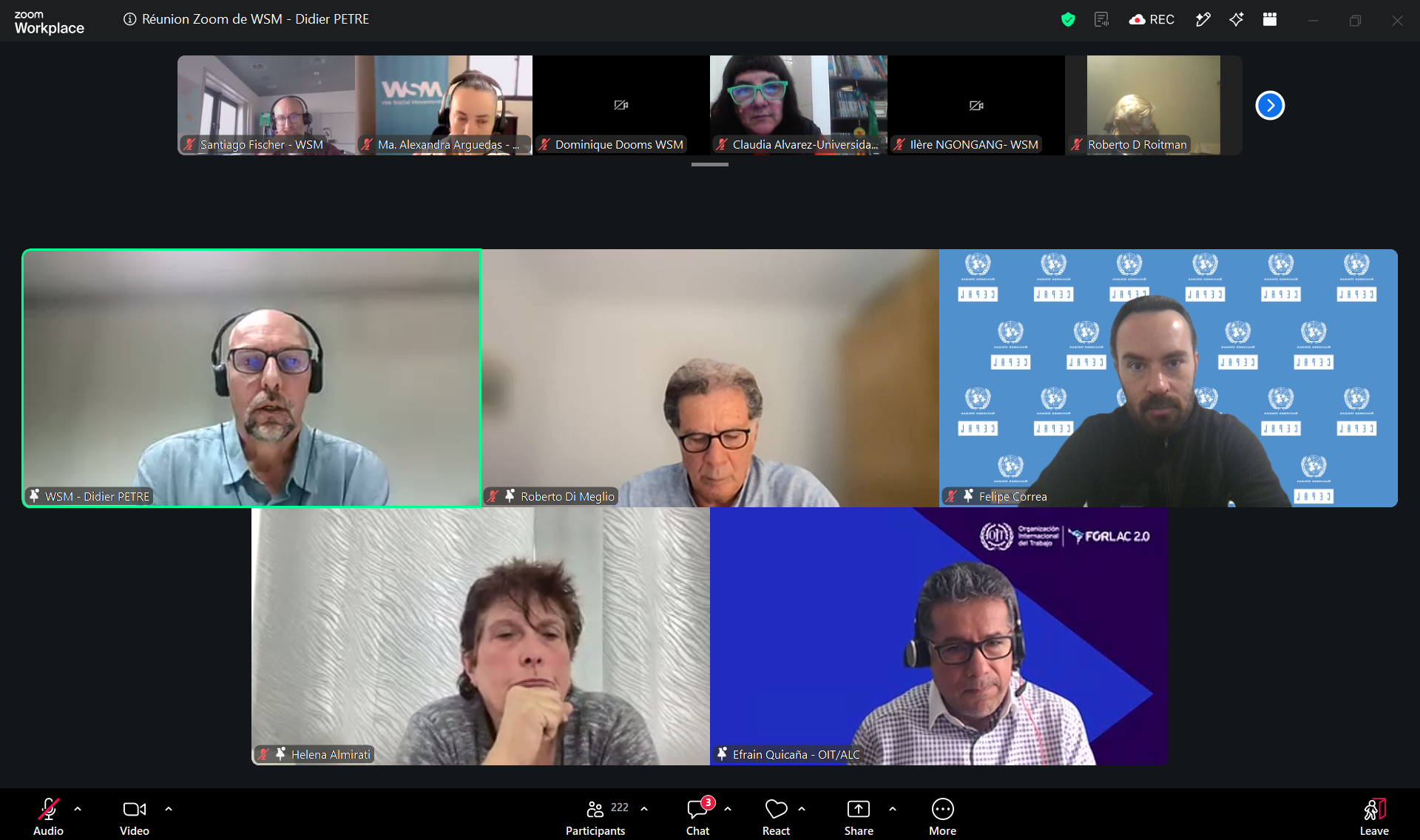
ECLAC took part in the webinar "Social and Solidarity Economy: Pathways to Build Another Development Model", organized by WSM (We Social Movements) and the INSP!R Network for Latin America and the Caribbean, held virtually with simultaneous interpretation in Spanish, English and French. The activity centred on the presentation of the Educational Guide, Social Solidarity Economy: Tools for the Implementation of the United Nations Resolutions, and brought together specialists from international organizations, regional networks and social and trade-union organizations. Felipe Correa, researcher at the Division of Production, Productivity and Management, took part on behalf of ECLAC as a panellist in the regional panel.
The SSE as a tool for integral development
In his remarks, Correa addressed the social and solidarity economy (SSE) from the perspective of integral development, understood —following authors such as Denis Goulet and declarations such as that of Cocoyoc (1975)— as a process centred on the human being, one that places the primacy of being over having at its core and puts the equitable, inclusive and sustainable well-being of people and the planet at the centre. Within this framework, he distinguished five dimensions of development —economic, social, political, human and sustainable— which influence one another and whose common purpose is well-being, or human flourishing.
On this basis, the researcher presented the SSE as a sector that, from the economic sphere, strengthens every dimension of development: it generates jobs and income; it builds cohesion, interpersonal trust and a sense of belonging; it fosters collective decision-making and democratic coexistence; it promotes modes of production and consumption attentive to environmental sustainability; and it places people's agency at its centre. He thus characterized the SSE as "an economy for well-being": another way of producing that, rather than maximizing profit, recovers the role that ancient philosophies —both Indigenous Latin American and European— assigned to the economy, namely, to satisfy human needs as a means of achieving buen vivir (good living).
A regional panel on decent work, social protection and sustainable development
ECLAC's participation took place within the panel "The SSE as a Tool for Decent Work, Social Protection and Sustainable Development", moderated by Santiago Fischer (WSM), which brought together different perspectives on the current moment of the SSE. Efraín Quicaña, regional rural economy specialist at the ILO Office for Latin America and the Caribbean, addressed the international resolutions and the SSE as a tool to promote decent work; Roberto Di Meglio, a specialist in the SSE, offered global perspectives on the sector and its future challenges; and Helena Almirati, of RIPESS International, reflected on the shift from international resolutions to territorial action and on the role of the organized SSE in transforming the development model.
A guide for the advocacy work of social and trade-union organizations
The core of the event was the presentation of the Educational Guide, prepared by the INSP!R Network for Latin America and the Caribbean with the support of WSM and presented in detail by Carlos Machuca, the consultant responsible for its preparation. Conceived as a pedagogical and advocacy tool aimed at social and trade-union organizations, the guide is organized into four modules covering the fundamentals of the SSE, the international framework that promotes it —with the United Nations resolutions and the ILO instruments—, an overview of the SSE in Latin America and the Caribbean, and a set of proposed lines of action and recommendations to strengthen policy advocacy. The prologue of the guide was written by Felipe Correa, on behalf of ECLAC, who invites the region's organizations and networks to take ownership of it as a tool to exercise their role in building an economy oriented towards well-being and buen vivir.
The UN resolutions and ECLAC's work on the social and solidarity economy
The social and solidarity economy is experiencing unprecedented political momentum. General Assembly resolutions A/RES/77/281 (2023) and A/RES/79/213 (2024) —preceded by the ILO Resolution concerning decent work and the social and solidarity economy (2022)— recognize the SSE as a relevant means of promoting more inclusive and sustainable development, and call on States to create enabling environments through appropriate legal frameworks, statistics and public policies. In the region, this momentum has translated into concrete advances, such as the Ibero-American Network for the Promotion of the Social and Solidarity Economy (RIFESS) and the legislation recently adopted in Costa Rica in 2026.
ECLAC supports this process through research, evidence generation and cooperation with countries —for example, through the Social and Solidarity Economy Observatory launched together with the Government of Costa Rica—, helping to integrate the SSE into the productive development strategies of Latin America and the Caribbean.
Related content

CEPAL participa en conferencia mundial sobre economía social y solidaria como modelo de desarrollo inclusivo para la región
Funcionario del organismo regional de las Naciones Unidas fue parte de un panel sobre los desafíos y perspectivas del cooperativismo latinoamericano.
CEPAL participa en encuentro internacional de la Red Intercontinental de Promoción de la Economía Social y Solidaria para América Latina y El Caribe
El encuentro congregó a 22 organizaciones de 12 países de la región y tuvo por objetivo fomentar y promover la economía social y solidaria en América ...
CEPAL participa en presentación de Guía publicada por el Foro Internacional de Economía Social y Solidaria
El documento busca servir como hoja de ruta para apoyar a los legisladores de la región en la creación e implementación de marcos regulatorios sólidos...