ECLAC encourages Latin American and Caribbean countries to advance toward ethnic-racial equality in the 2030 Agenda
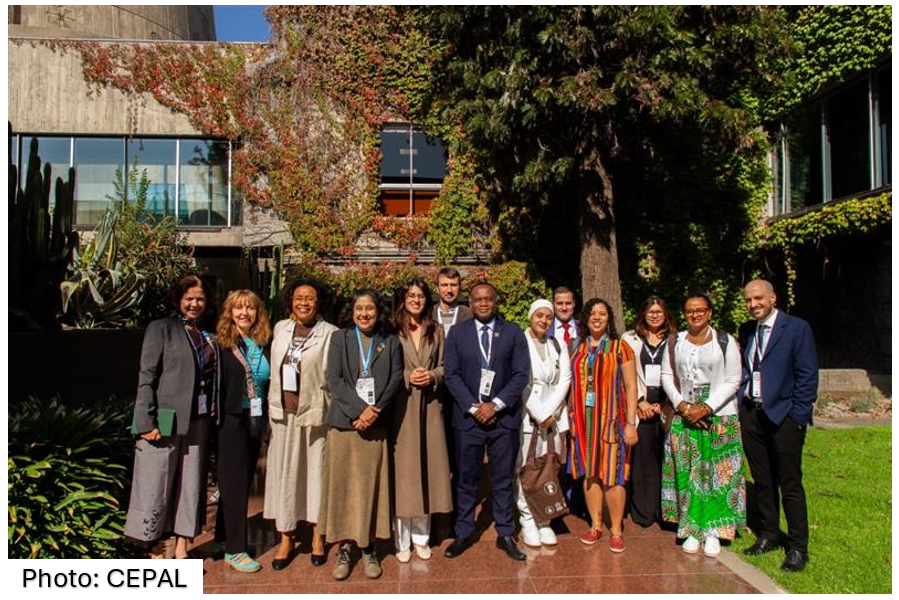
The Economic Commission for Latin America and the Caribbean (ECLAC) encouraged countries in the region to strengthen the incorporation of ethnic-racial equality into the implementation and follow-up of the 2030 Agenda for Sustainable Development, and underscored the importance of having high-quality, timely, and disaggregated data that make structural inequalities visible and help guide more effective public policy responses.
This was one of the main messages of the side event “Ethnic-Racial Equality in the 2030 Agenda and SDG 18: data and monitoring to leave no one behind”, held on April 13, 2026, at ECLAC headquarters in Santiago, Chile, within the framework of the Ninth Meeting of the Forum of the Countries of Latin America and the Caribbean on Sustainable Development. The activity was organized by Brazil’s Ministry of Racial Equality and ECLAC, in a hybrid format with simultaneous interpretation in Spanish, English, and Portuguese.
The meeting aimed to share strategies and experiences to expand the availability and quality of disaggregated data on Afro-descendant populations, as well as to discuss institutional initiatives and monitoring platforms that contribute to strengthening the ethnic-racial dimension in the implementation and follow-up of the 2030 Agenda in Latin America and the Caribbean.
Opening remarks were delivered by Cledisson Geraldo dos Santos Júnior, Secretary at Brazil’s Ministry of Racial Equality; Thiago Gehre Galvão, Advisor to Brazil’s National SDG Commission; Lennon Ferreira Corezomaé, Director at the Ministry of Indigenous Peoples; and Camila Gramkow, Director of the ECLAC Office in Brazil.
The roundtable was moderated by Mayra Juruá, programme management officer at the ECLAC office in Brazil, and included presentations by Tatiana Dias Silva, from the Ministry of Racial Equality; Kenia Muniz, representative of the Department of Chipas in Mexico; Fabiana Del Popolo, Chief of the Demography Area of CELADE-Population Division of ECLAC; Rolando Ocampo, Director of ECLAC’s Statistics Division, together with representatives from the Brazilian Institute of Geography and Statistics (IBGE), academia, and civil society.
During the meeting, participants highlighted Brazil’s experience regarding SDG 18 on Ethnic-Racial Equality, a goal voluntarily adopted by the country to promote ethnic-racial equality, with special attention to inequalities affecting Indigenous Peoples and Afro-descendant populations. The role of new monitoring tools, such as the SDG Racial Platform, was also emphasized. This platform was designed to support the monitoring and evaluation of indicators aligned with the 2030 Agenda and to guide evidence-based public policies.
ECLAC underscored that this debate is directly linked to the commitments assumed by Latin American and Caribbean countries in the Montevideo Consensus on Population and Development, particularly chapters H and I, concerning Indigenous Peoples and Afro-descendants. In this regard, participants emphasized during the event that advancing toward a regional agenda for ethnic-racial equality requires a stronger articulation of statistical production, monitoring, social participation, and public policy design.
The need to make better use of available information sources, including population and housing censuses, surveys, and administrative records, was also emphasized in order to make visible the persistent gaps affecting Afro-descendant and Indigenous populations, as well as other historically discriminated groups. This approach converges with target 17.18 of the Sustainable Development Goals, which calls for increasing the availability of high-quality, timely, and disaggregated data.
Through initiatives such as this, ECLAC reaffirms its commitment to strengthening countries’ statistical capacities and promoting evidence-based public policies that enable progress toward sustainable development with equality and without leaving anyone behind.