It is in Latin America and the Caribbean’s Best Interest to Strengthen Economic and Cooperative Relations with India to Boost Growth and Enhance Development
Work area(s)
In an international seminar organized by ECLAC, experts exchanged their analytical perspectives and held a strategic dialogue to advance toward a shared roadmap.
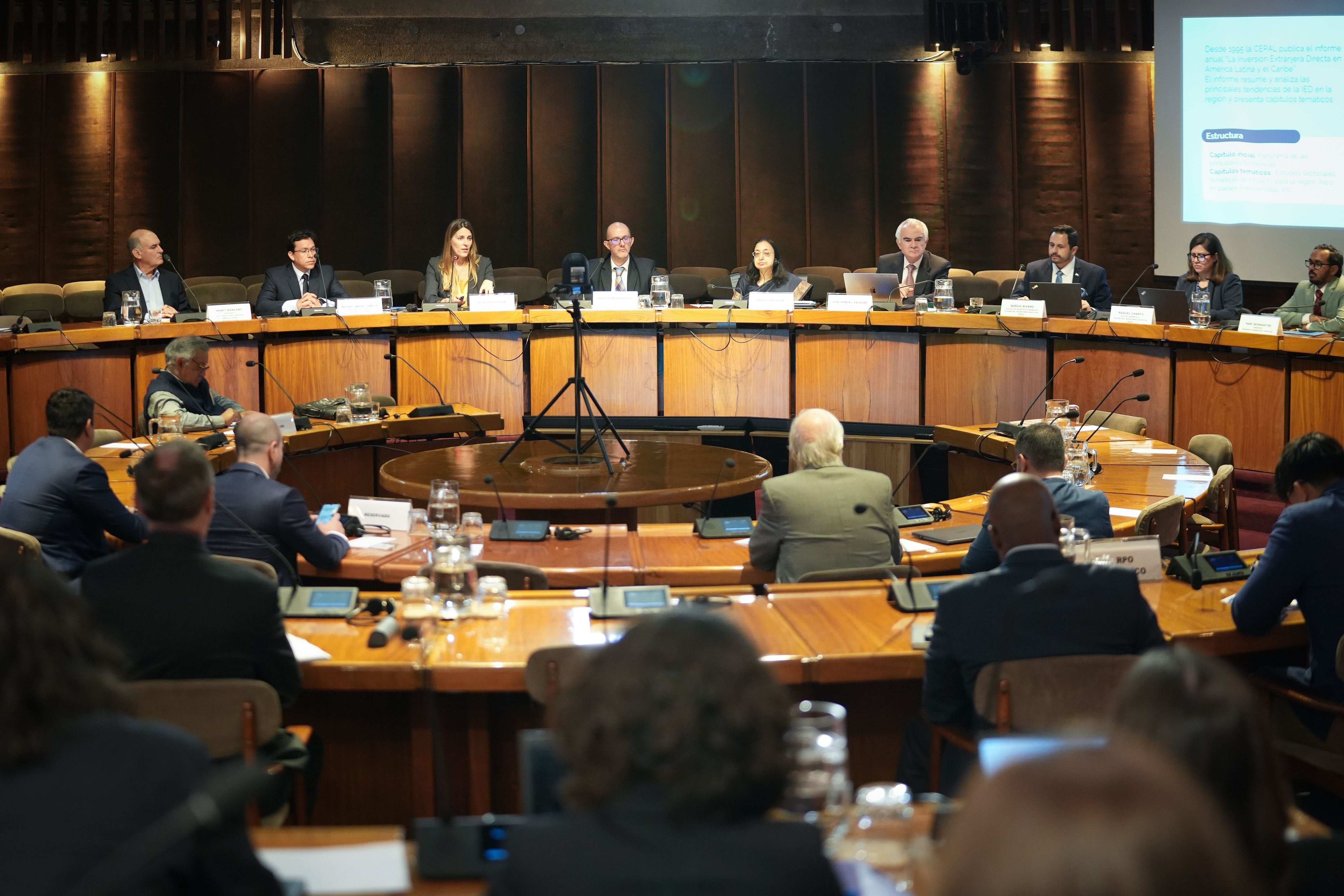
At an international seminar organized by the Economic Commission for Latin America and the Caribbean (ECLAC), experts agreed that it is in Latin America and the Caribbean’s best interest to strengthen and expand economic and cooperative relations with India to boost its economic growth and enhance development. The seminar was held at ECLAC headquarters in Santiago, Chile.
During the seminar, titled India–Latin America and the Caribbean: Emerging partners in a shifting global economy, experts exchanged analytical perspectives and held a strategic dialogue aimed at working toward a shared roadmap to strengthen this partnership and explore new opportunities for cooperation.
The seminar was opened by José Manuel Salazar-Xirinachs, ECLAC Executive Secretary, and by Abhilasha Joshi, Ambassador of India in Chile.
“The main consideration proposed by this seminar is the need to reframe international integration of Latin America and the Caribbean through foresight. Integration with the world must be managed intelligently, that is, as a political tool to boost growth and development, drive productive transformation, bolster the region’s numerous assets, and maintain mutually beneficial relationships with a growing number of trade and economic partners,” José Manuel Salazar-Xirinachs stated.
He emphasized that India is currently one of the world’s most dynamic emerging economies, with a GDP of nearly 3.7 trillion dollars and a population of more than 1.4 billion people. He added that it is currently the fifth-largest economy worldwide, set to become the third-largest by 2030, driven by a high growth rate and a process of deep transformation that can provide valuable lessons for Latin America and the Caribbean.
The ECLAC Executive Secretary noted that although economic relations between India and the region have shown increased momentum—with bilateral commerce of nearly 50 billion dollars—they are still far from fulfilling their potential. Exchange is currently concentrated on a small number of products, with little presence of goods and services with a greater added value. However, current negotiations, such as the CEPA with Chile, the FTA with Peru, and the expansion of the India-Mercosur agreement, are evidence of growing interest and an expanding economic agenda, he stated.
“Latin America and the Caribbean must complement their traditional economic ties with a broader strategy of diversification toward emerging economies like India, the Gulf countries, ASEAN, and Africa. This proposal does not mean diminishing the importance of our main partners, such as the United States, China, and the European Union or countries within the region, with whom we maintain solid relationships. Instead, it aims to complement that architecture with new spaces of cooperation that allow the region to act with greater agility in a more competitive global landscape,” he said.
“This means building resilience and a capacity for foresight, broadening our productive base, leveraging commercial and technological complementarities, and along with all this, adding very necessary drivers of growth and forms of reducing exposition to external socks that imply higher costs for our economies and societies,” added ECLAC’s Executive Secretary.
In closing, José Manuel Salazar-Xirinachs noted that in an economy and global landscape characterized by strong industrial and technological rivalry that are increasingly weaponized and competitive, the countries and regions that combine resilience, foresight, and proactive action will have the greatest chances of improving their path of development.
“The future of the relationship between India and the region will depend on our ability to transform spaces like these into inputs for public policy, corporate partnerships, public-private projects, and mechanisms for sustainable cooperation. I hope this seminar will be a jumping-off point to compare analyses, share experiences, identify alignments, and work toward a shared roadmap,” he concluded.
For her part, the Ambassador to India in Chile, Abhilasha Joshi, emphasized that in a changing landscape, India and Latin America and the Caribbean are discovering new paths for cooperation.
“On this journey to bring our regions closer together, multilateral forums like ECLAC play a crucial role by providing analytical knowledge and platforms for dialogue,” she stated.
She added that India’s message to Chile and all other countries in the region “is one of cooperation, ambition, and shared prosperity (...). I’m sure that in the coming years, we will see a broader, deeper collaboration between India and Latin America and the Caribbean, with a greater impact than ever,” she said.
The India-Latin America and the Caribbean International Seminar included two high-level panels in which experts and specialists both from the region and from India debated topics such as bilateral relations in a transforming global economy and new frontiers to expand cooperation in trade and investment.
Contact
Public Information Unit
- prensa@cepal.org
- (56 2) 2210 2040