During a Lecture at ECLAC, the Undersecretary of State from Poland’s Foreign Affairs Ministry Points Up the Polish Transformation Model
Work area(s)
The prominent diplomat was received by José Manuel Salazar-Xirinachs, the United Nations regional organization’s Executive Secretary.
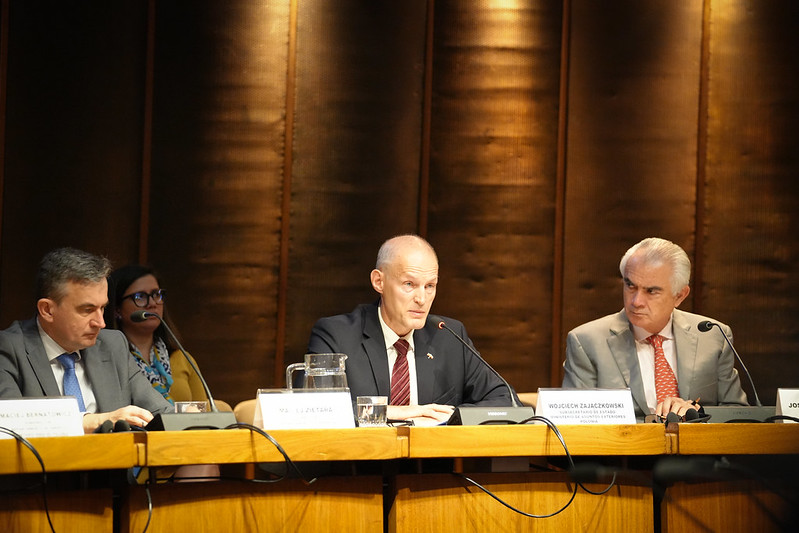
In the last 35 years, Poland has gone from being a developing country to consolidating itself as a developed nation, and from a centrally planned economy to a fully market economy, Wojciech Zajączkowski, Undersecretary of State at the Ministry of Foreign Affairs of Poland, stressed today in a keynote lecture he delivered at the main headquarters of the Economic Commission for Latin America and the Caribbean (ECLAC) in Santiago, Chile.
The diplomat gave a lecture entitled “The Polish transformation model” in which he analyzed his country’s development over the last three decades, reflected on the global scenario, and announced Poland’s intention to take a “more active (role) in Latin America.” The opening remarks to the lecture were made by José Manuel Salazar-Xirinachs, ECLAC’s Executive Secretary.
“The results speak for themselves. Since 1989, Poland has avoided long-term stagnation, built a stable market economy and grown into an active hub deeply integrated with the global value chains. The nominal GDP has grown more than 13 times; Foreign Direct Investment has increased more than 300 times; exports have risen more than 28 times; and the share of world trade has nearly quadrupled since 1990,” Wojciech Zajączkowski said in his speech.
The diplomat noted that his country’s history has been marked by “dramatic highs and lows,” going from being Europe’s largest state in the 16th century to suffering partitions, wars and decades of Soviet control. “After World War II, Poland lost millions of lives and much of its wealth, entering a long period of hardship,” he recalled.
However, he added that since 1989, Poland has reacted quickly and society “adapted, learned and rebuilt.”
“Political leaders made courageous decisions. Poland opened itself to the world, to trade, investments, ideas and partnerships. Integration with European institutions and later with NATO anchored us in a community of democracy and security. It encouraged investments, expanded trade and allowed us to benefit from global growth. Civil society and human capital became engines of this new momentum. Unity during decisive moments allowed reforms to continue, despite immense social hardship,” he explained.
Zajączkowski stressed that Poland’s geopolitical and geoeconomic relevance has grown substantially since the pandemic and after the Russian invasion of Ukraine. This transformation, he added, makes Poland an example of a country that is moving towards development in the midst of a complex international scenario.
“Poland’s history proves that deep reforms are possible, that nations can rise from difficult circumstances, that growth can be inclusive, and that democratic institutions can regain public trust when they deliver real improvements in people’s lives. These are lessons relevant to any country seeking stability, prosperity and robust sovereignty. Poland stands ready to share its experience, not as a teacher, not as a model, but as a partner who has walked a similar road and knows how difficult, but also how rewarding that journey can be,” he affirmed.
Meanwhile, José Manuel Salazar-Xirinachs, ECLAC’s Executive Secretary, asserted that in this era in which geopolitical rivalries and tensions between the main powers are intensifying and armed conflicts are escalating, listening and drawing lessons from other experiences is very important for understanding the transformations that are taking place in the global arena, and in Europe in particular.
“The current challenges are marked by a globalization redefined by the unilateral use of power and weaponized interdependence on trade, financial and political matters; an era of constant disruptions associated with wars, negotiations between major powers, climate change, technological revolutions, demographic changes and others. This is also a very difficult time for the multilateral system and for the agendas it had negotiated and set during its 80 years in existence,” he stated.
ECLAC’s Executive Secretary recalled that the United Nations is celebrating its 80th anniversary in 2025, and the challenges facing the world are enormous. In that regard, he stressed that the United Nations Charter continues to be the road map, and that multilateralism is the only way to address today’s conflicts and challenges.
“Poland is a country committed to fulfilling its international commitments. As a member of the United Nations and the Economic Commission for Europe, it has affirmed its commitment to the 2030 Agenda for Sustainable Development and it has presided over and organized the United Nations Framework Convention on Climate Change on four occasions. Just a few weeks ago, at the COP30 in Belém do Pará, Poland and Mexico co-facilitated a key pillar of the negotiations: the creation of a Just Transition mechanism with the goal of ensuring that mitigation and decarbonization policies go hand in hand with social justice, equity, human rights and protection of the most vulnerable groups and that the move towards clean energy be just, inclusive and equitable,” he emphasized.
The keynote lecture by Wojciech Zajączkowski took place in the framework of the official visit that the Undersecretary of State from Poland’s Ministry of Foreign Affairs is making to Chile, in commemoration of the 105 years of diplomatic relations between the two countries.