Energy efficiency in transportation
Work area(s)
Topic(s)
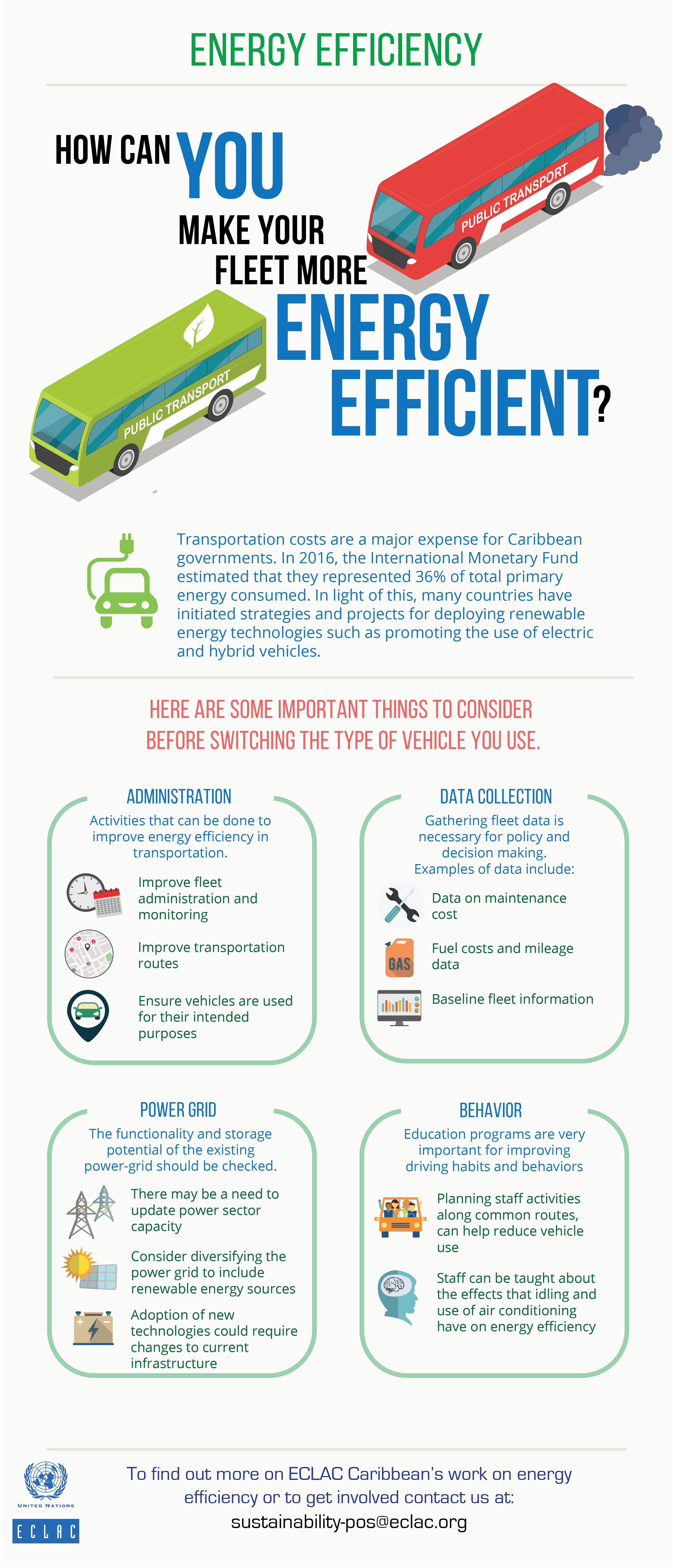
** Please don't hesitate to share with your partners or publishing associates.<br />
*** The infographics and fact sheets may not be altered, transformed, or built upon and you must attribute the work to ECLAC in the manner specified.</p>
Teaser
Most small island developing States (SIDS) are net
energy importers and utilize mainly fossil energy
sources to drive their economies and meet social
needs. Fossil energy is used primarily for power
generation and domestic transportation. In light of
the global challenges that arise from climate change,
many countries have initiated strategies and projects
for deploying renewable energy technologies, as
well as enhancing energy efficiency (EE). In 2016,
the International Monitory Fund (IMF) estimated that
transportation accounted for 36 per cent of the total
primary energy consumed in the Caribbean subregion.
This information highlights the importance of increasing
energy efficiency in the transportation sector as one
of several strategies to improve sustainability. To date
however, efforts to transition to renewable energy (RE)
and to enhance EE in domestic transportation systems
remain very limited.
Related content
ECLAC assists Cayman Islands with new national energy policy
A priority goal of the Cayman Islands new national energy policy is to decrease energy costs in the country, in light of the very high price of energy in the country.
BIEE Programme Launch in the Caribbean & Capacity Building Workshop on Energy Efficiency Indicators
ECLAC, with the support of the German Agency for International Cooperation (GIZ) and the French Environment and Energy Management Agency (ADEME) is currently developing a Database for Energy…
Sustainable energy for all in the Caribbean
Briefing note by ECLAC Caribbean Chief, Diane Quarless
Subregional headquarter(s) and office(s)
Related link(s)
Attachment(s)
Country(ies)
- Caribbean