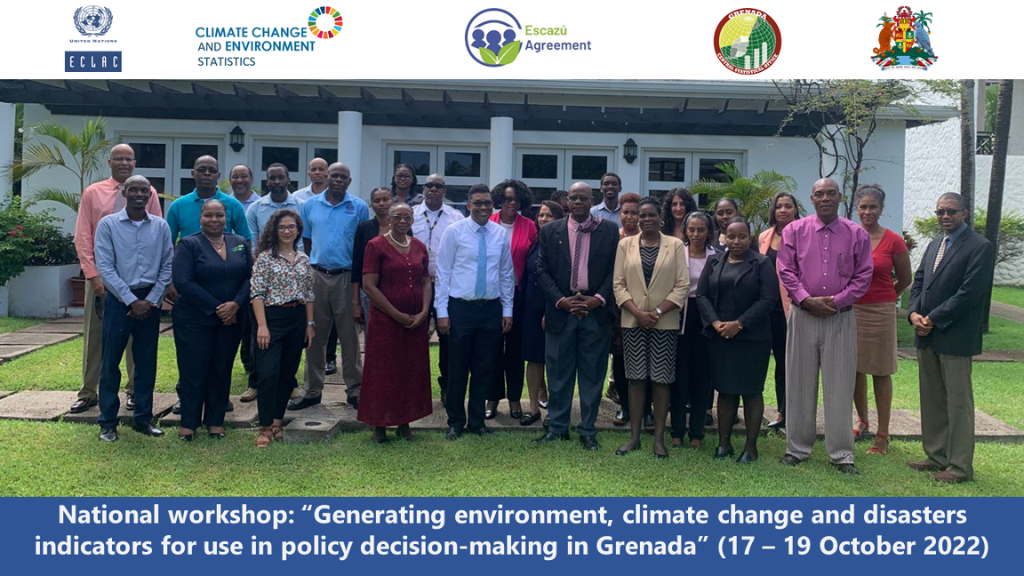
Grenada: National workshop on generating climate change and disasters indicators for policy decision-making

17 Oct 2022 | Event
<span>Grenada: National workshop on generating climate change and disasters indicators for policy decision-making</span>

Event information

The Caribbean region is acutely threatened by climate change, particularly the Small Island Developing States (SIDS). Grenada is no exception. The country is situated in the tropical cyclone belts and is directly exposed to the forces of the oceans. And as a small geographical area, disasters might affect vast proportions of the country. Availability of quality statistics and indicators are crucial to effectively respond to the effects of climate change and build resilience.

Date

17 - 19 Oct 2022, 05:40 - 12:00

Event type

Meetings and technical symposiums

Address

St. George
Coyaba Beach Resort, Saint George
Grenada
Background

The Caribbean region is acutely threatened by climate change, particularly the Small Island Developing States (SIDS). Grenada is no exception. The country is situated in the tropical cyclone belts and is directly exposed to the forces of the oceans. And as a small geographical area, disasters might affect vast proportions of the country. Availability of quality statistics and indicators are crucial to effectively respond to the effects of climate change and build resilience.

Against this backdrop, the ECLAC´s Statistics Division, Sub regional Office for the Caribbean, in collaboration with the Sustainable Development and Human Settlements Division, are joining forces to enhance the production and use of key indicators and metrics to monitor and adapt to the effects of climate change and strengthen Environmental Information Systems (EIS). These efforts, supported by the Development Account of the United Nations, aim to boost the environmental pillar of the 2030 Agenda and improve policy coherence in the implementation of the Escazú Agreement, the Revised St. George´s Declaration (SGD 2040), the SAMOA Pathway, the Paris Agreement, and the Sendai Framework.

Objectives
  • Train the participants to build selected environment, climate change and disaster indicators and its metadata.
  • Identify data and capacity gaps to develop an Environmental Information System (EIS) and build a regional resilience platform.
  • Have a better understanding of how geospatial data can enhance the use of environment, climate change and disaster indicators for effective decision making.
Expected outcomes
  • At least three prioritized climate change and disasters indicator and its metadata are available at the end of the workshop.
  • A selection of prioritized indicators from the Global Set of Climate Change Indicators are identified for Grenada.
  • Follow up steps to build further selected climate change and disasters indicators are agreed with the national focal points from the Central Statistical Office of Grenada and the Ministry of Climate Resilience, the Environment and Renewable Energy.

Programme of work

17 October 2022

  • Inaugural session and introduction to the workshop

    -

    Facilitator: Abdullahi Abdulkadri, Coordinator of Statistics and Social Development Unit, ECLAC Caribbean

    ▪ Faustina Wiggins, CARICOM Secretariat

    ▪ Chamberlain Emmanuel, Environmental Sustainability Division, OECS

    ▪ Reena Shah, Environment Statistics Section, UNSD

    ▪ Rolando Ocampo, ECLAC Statistics Division

    ▪ Hon. Lennox Andrews, Ministry of Economic Development, Planning, Tourism, ICT, Creative Economy, Agriculture and Lands, Fisheries & Cooperatives

    Presentation(s)
  • 1. Global and regional enabling frameworks and strategies

    -
    Presentation(s)
  • 2. Environment, climate change and disasters indicators for Grenada needs and priorities

    -
    Presentation(s)
    • 2.1 National policies and plans where environment, climate change and disaster indicators are required

    •   - La Verne Mapp, Planning Officer, Ministry of Agriculture and Lands; Fisheries and Cooperatives

    •   - Tonya Hyacinth, Deputy Disaster Coordinator (Ag.), National Disaster Management Agency (NaDMA)

    •   - Aria St.Louis, Ministry of Climate Resilience, the Environment and Renewable Energy, Government of Grenada

    •   » Q&A Session

    • 2.1.1 Group dynamic: demand for and priority indicators along the policy-making cycle, by group

      Iskuhi Mkrtchyan, ECLAC

    • 2.1.2 Group dynamic: groups report back to plenary

    • 2.2 Individual work: Review the Global Set of Climate Change Indicators and select priority indicators for the country

      Iskuhi Mkrtchyan & Karina Cázarez, ECLAC

    • 2.3 Presenting the indicator to be built during the workshop

      Karina Cázarez, ECLAC

    • Conclusion of the day and what to expect for day 2

      Georgina Alcantar, ECLAC

    • End of day 1

      Abdullahi Abdulkadri, ECLAC

18 October 2022

  • 3. What is needed to produce environment, climate change and disaster statistics and indicators?

    -

    Facilitator: Karina Cázarez, ECLAC

    Presentation(s)
  • 4. How to produce environment, climate change and disaster statistics and indicators?

    -
    Presentation(s)
  • 5. Building selected environment climate change and disasters indicators with national data

    -
    Presentation(s)
    • 5.1 Instructions for group work

      Karina Cázarez, ECLAC

    • 5.2 Group work: building selected climate change and disasters indicators and their methodological sheets

      All participants

    • - Insights from the working groups

    • Conclusions of the day and what to expect for day 3

      Karina Cázarez, ECLAC

    • End of day 2

      Abdullahi Abdulkadri, ECLAC

19 October 2022

  • 6. Recap from day 2 and introduction to day 3

    -

    Facilitator: Iskuhi Mkrtchyan, Statistics and Social Development Unit, ECLAC Caribbean

    Iskuhi Mkrtchyan, ECLAC

    Welcome and introduction to day 3 of the workshop
    Janet Geoghagen-Martin and Paula Fuenzalida, ECLAC

    Interactive Recap from day 2 


  • 7. Presentation of group work results: indicators and methodological sheets

    -
    All groups present their indicators and methodological sheets
    Remaining groups present their indicators and methodological sheets and receive feedback from the audience and the ECLAC team
  • 8. Towards an environmental information system in Grenada

    -
    Presentation(s)
    • 8.1 Instructions for group work

      Karina Cázarez, ECLAC

    • 8.2 Group work: dissemination and sustainability of the new indicators: challenges & potential Solutions by groups

      Iskuhi Mkrtchyan, ECLAC

    • 8.2 Reporting back from group work

    • 8.3 Recommendations to establish an Environmental Information System

      Francisco Jiménez, ECLAC

    • 8.4 Evaluation of the workshop

    • Closing remarks

      Halim Brizan, Director, Central Statistical Office of Grenada & Georgina Alcantar, ECLAC

    • End of the workshop

      Abdullahi Abdulkadri, ECLAC

Organizing institution

Logo eclac

ECLAC

Logo CEPAL Naciones Unidas

ECLAC Subregional Headquarters for the Caribbean

Subscription

Get ECLAC updates by e-mail.