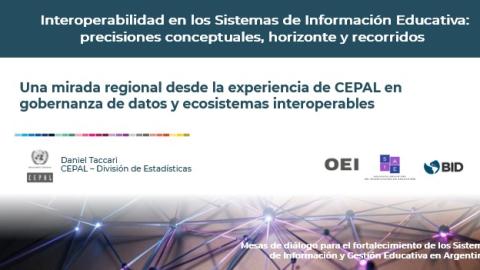
ECLAC participates in the 12th edition of the ‘Dialogue Roundtable for Strengthening Education Information and Management Systems in Argentina’
Work area(s)
Topic(s)

This initiative, organized by the Inter-American Development Bank (IDB), the Organization of Ibero-American States (OEI), and the Argentine Society of Education Researchers (SAIE), aims to promote the strengthening of Education Information and Management Systems (SIGED) in Argentina, expand their uses, and advance discussions on issues related to the production, integration, and use of information for the planning, management, and monitoring of educational policies, programs, and interventions.
In its twelfth edition, the Roundtable explores the concept of interoperability. When information on students, teachers, institutions, infrastructure, programs, and resources is fragmented, duplicated, or dispersed, the ability to make timely decisions and direct interventions where they are most needed is limited. Conversely, having integrated, reliable, and timely information makes it possible to improve planning, strengthen the monitoring of educational trajectories, and develop more appropriate responses for schools, territorial teams, and management areas.
In a context where educational information is often distributed across multiple systems, records, and platforms, interoperability helps improve coordination among administrative units, levels of government, and institutions; reduce duplication; streamline administrative processes; strengthen the traceability of student educational pathways; integrate administrative, statistical, and assessment information; and generate better inputs for decision-making. Its ultimate value lies in helping education systems more accurately identify where gaps persist, which students, schools, or territories require greater support, which policies are producing positive results, and how resources can be allocated to improve learning opportunities.
On this occasion, ECLAC presented a regional perspective based on its experience in data governance and interoperable ecosystems.
Image
These meetings, which have brought together stakeholders from provincial, national, and regional levels, seek to share knowledge on what is known, what has been developed, and what challenges remain regarding the design, implementation, and use of Education Information and Management Systems (SIGED), particularly Early Warning Systems (EWS) and Student Pathway Protection Systems (SPT) in the country. Throughout the different editions, the roundtables have brought together specialists, national and provincial government officials, technical and territorial teams, school leaders, representatives of cooperation agencies, researchers, and members of organizations working on educational information, management, and evidence-based decision-making.
Country(ies)
-
 Argentina