From Digital “Islands” to a Regional Digital Spine: ECLAC Advance Study on Digital Harmonisation in the OECS
Work area(s)
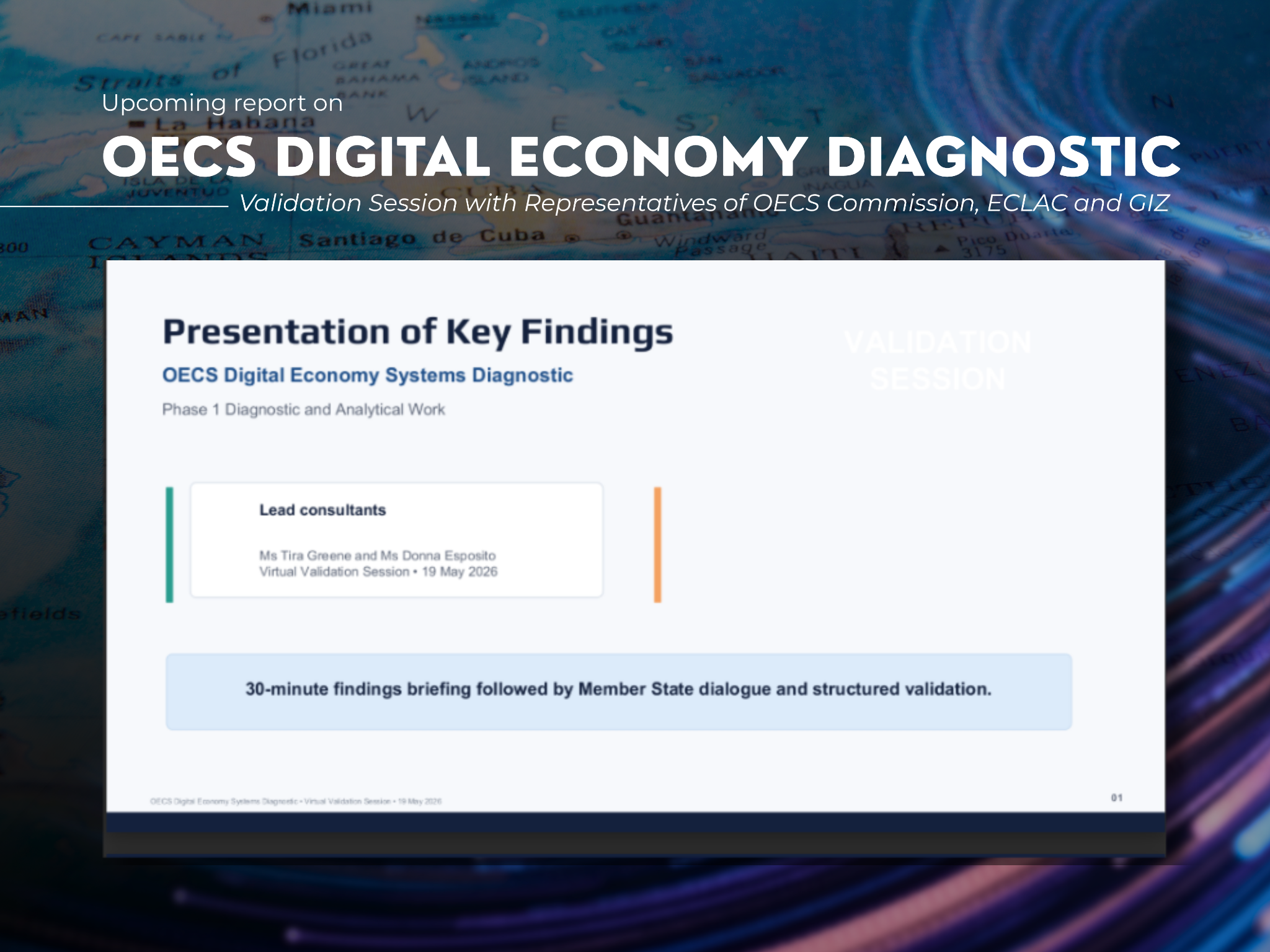
The Economic Commission for Latin America and the Caribbean under the mandate of eLAC Digital Agenda and within the framework of ECLAC GIZ Digital Transformation Laboratory is moving forward with the preparation of a study on the harmonisation of digital economies across the member countries of the Organisation of Eastern Caribbean States (OECS).
During a technical validation meeting, authorities, specialists and representatives from participating countries reviewed the progress of the document and agreed on the need for the study to contribute not only to producing diagnoses, but also to building concrete and actionable digital agendas for the region.
That vision was shared by both ECLAC and German development cooperation. As Sebastián Rovira, Chief of ECLAC’s Digital Transformation Unit, noted, the support provided “is not simply about producing another report”, but rather about developing an implementable framework capable of delivering tangible benefits to OECS countries.
Along the same lines, Franziska Seiffarth, Digital Learning and Transformation Specialist of GIZ, highlighted that the study provides the analysis required to move towards digital agendas that are “realistic and actionable”. She also stressed that these policies must be “regionally grounded analyses”, recognising the differing institutional and governance realities of each member State while strengthening regional cooperation.
During the meeting, OECS Director General Didacus Jules argued that small island developing States must harness digital transformation to overcome historical constraints associated with geography, scale, market size and economic vulnerability. In that context, he stated that digital capacity can become a genuine “force multiplier”, enabling countries to compete beyond the limitations imposed by their physical size.
A study responding to a regional need
Indeed, one of the points most frequently raised during the meeting was the relevance of the study in the current OECS context. Jules described it as “one of the most comprehensive studies ever done on region”, while representatives and focal points from member States positively assessed both the scope of the research and its potential to guide future regional digital agendas.
The discussion also served to gather technical observations and feedback from participating countries, as part of a process aimed at validating the study’s main findings and strengthening its future implementation framework.
From isolated systems to a regional architecture
The meeting also provided an opportunity to present progress on the research led by Tira Greene, lead consultant and author of the document, who explained that the study approaches digital transformation through an interconnected ecosystem of legal, institutional, technical and operational dependencies.
That approach has led to the proposal of a paradigm shift: moving away from digital service “islands” towards a regional backbone that would allow different systems to stop operating independently and instead become integrated within a common framework.
Green explained that several OECS member States already have relevant digital systems in place, including customs platforms, online government services, tax systems and business registries. However, many of these tools continue to operate in isolation, limiting opportunities for interoperability and regional coordination.
The final report, which will be presented in the coming months, will place particular emphasis on regional convergence and on building a common implementation framework for OECS countries. The aim is to promote a whole-of-government approach to digital transformation, recognising that fragmented efforts by individual ministries or agencies are insufficient to sustain a modern digital economy.
The initiative forms part of a broader vision promoted by ECLAC regarding the role of digital technologies as a driver of productive development, inclusion and institutional strengthening in Latin America and the Caribbean. In recent publications, the regional commission has stressed that digital transformation represents an opportunity to overcome the structural development traps facing the region, particularly those linked to limited growth capacity.
