How can international bond markets help advance gender equality in Latin America and the Caribbean?

What are gender-focused bonds?
Gender-focused bonds have emerged within the broader expansion of sustainable finance as a way to mobilize resources toward gender equality. The report Capital flows to Latin America and the Caribbean: a decade of gender-focused bond issuance in international markets examines the evolution of these instruments between 2016 and 2025.
Use‑of-proceeds bonds direct financing toward activities such as women's financial inclusion and support for women-owned businesses, while sustainability-linked bonds incorporate measurable gender-related targets into financing conditions, including targets for women's representation in leadership and on corporate boards.
In 2016, Chile's state-owned BancoEstado placed the region's first gender-focused bond in international markets (a use-of-proceeds instrument), supporting women's financial inclusion. Since then, the market has expanded to encompass sovereign issuances, a broader range of corporate issuers, and larger transactions incorporating different financing structures and gender‑related objectives.
Image
Why does it matter?
Advancing gender equality requires sustained financing and the mobilization of resources from both public and private sources. The Regional Gender Agenda recognizes financing as an essential component of efforts to strengthen women's autonomy and advance more inclusive development.
In this context, gender-focused bonds offer an additional channel for mobilizing financial resources while incorporating gender-related objectives into broader financing strategies. They can help direct financing toward women's economic opportunities and encourage measurable commitments to greater participation in decision-making.
However, their contribution to gender equality depends on more than access to financing. Clear objectives, measurable commitments and credible reporting are essential for assessing results.
How can international bond markets contribute?
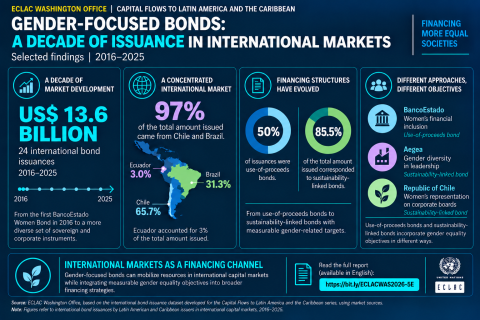
Between 2016 and 2025, Latin American and Caribbean issuers placed 24 gender-focused bonds in international markets, totalling US$ 13.6 billion.
Although the market has increasingly diversified, issuance remains highly concentrated: Chile and Brazil accounted for approximately 97% of the total amount issued, with Ecuador representing the remaining 3%. The financing structures have also evolved. Sustainability-linked bonds accounted for half of the transactions but 85.5% of the total amount issued, reflecting the larger size of transactions incorporating measurable gender-related targets.
Experiences from BancoEstado in Chile, the Republic of Chile and Aegea in Brazil show how international bond financing can support different objectives, from women’s financial inclusion to greater representation in leadership and corporate boards. Their broader lesson is that gender-focused bonds are more likely to support meaningful progress when embedded in broader institutional and policy frameworks and supported by clear targets, transparent reporting and credible mechanisms for measuring results.
Ultimately, the value of these instruments lies not only in how much financing they mobilize, but in how effectively that financing contributes to advancing gender equality.
Related content
Country(ies)
- Latin America and the Caribbean