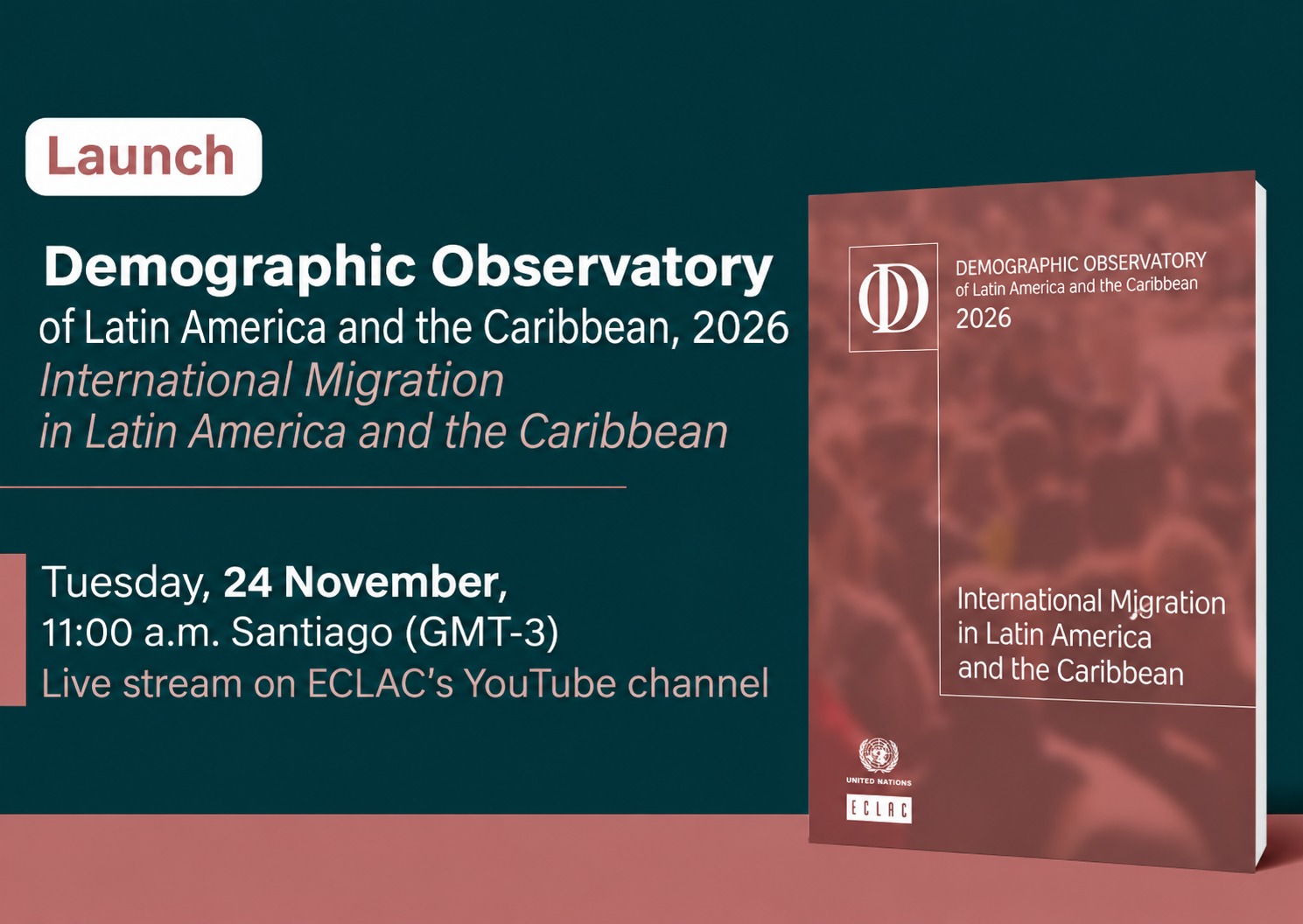
The region has maintained a negative international migration balance since the mid-twentieth century, meaning that departures to destinations outside the region continue to exceed arrivals. Although the United States remains the main destination for emigrants from Latin America and the Caribbean, migration between countries within the region has also become increasingly important in recent decades. In 2024, around 48 million people born in the region were living outside their country of birth: 57% in North America, nearly 29% in another country in Latin America and the Caribbean, and 12.7% in Europe. Venezuelan emigration has been a major factor in the growth of intraregional migration.
The availability of timely, reliable and comprehensive data on international migration remains a challenge for the region. The document therefore examines the main data sources and the challenges involved in improving their availability, quality, coverage and comparability. It also analyses the demographic impact of international migration using a zero-net-migration scenario from 1990 onward. Finally, the document examines the factors associated with migration, regulatory frameworks and the contributions of migrants to societies of origin and destination. Social and labour inclusion, migration regularization and the elimination of discrimination are essential to maximizing these contributions. In this context, it is essential to strengthen data systems and promote a new public narrative on migration based on evidence, human rights and inclusion.
Schedule
Moderator: Simone Cecchini, Director, CELADE-Population Division, ECLAC
11:00–11:10 a.m. Opening remarks
- José Manuel Salazar-Xirinachs, Executive Secretary, ECLAC
- Paula Narváez, Regional Director for Latin America and the Caribbean, United Nations Population Fund (UNFPA)
- Olivier Najar, Senior Operations Economist, Latin America Department, French Development Agency (AFD)
11:10–11:40 a.m. Presentation of the Demographic Observatory 2026
- Helena Cruz Castanheira, Population Affairs Officer, CELADE-Population Division, ECLAC
- Fabiana Del Popolo, Chief, Demography and Population Information Area, CELADE-Population Division, ECLAC
11:40 a.m.–12:20 p.m. Expert comments
- Felipe Muñoz Gómez, Chief, Migration Unit, Inter-American Development Bank (IDB)
- Jorge Muiño, Director General for Consular Affairs and Liaison, Ministry of Foreign Affairs of Uruguay; Chair of the National Migration Board
- Marcela Cerrutti, Researcher, Center for Population Studies (CENEP), Argentina
12:20–12:50 p.m. Q+A
12:50–1:00 p.m. Closing remarks
- Juan Francisco Espinosa, Regional Director for Latin America and the Caribbean, International Organization for Migration (IOM)